-
The Red Circle on the Budget Spreadsheet
-
Six Weeks Later, the Boots Started Falling Apart
-
Doing the Homework I Should Have Done First
-
The Lacing Lesson That Changed My Boot Spec
-
The Order That Made Finance Hold Their Breath
-
What Happened After Delivery
-
The Math That Finally Made Sense
-
The Bottom Line for Anyone Who Buys PPE
The Red Circle on the Budget Spreadsheet
Back in 2020, when I took over purchasing for a 140-person electrical contracting company, I had no idea what I was doing. I'm the office administrator, so I handle all the PPE and uniform ordering—roughly $60,000 a year across 12 vendors. I report to both operations and finance, which means I get pulled in both directions.
But the lesson that really stuck came in early 2024. The finance director handed me back the annual boot budget with a red circle around one line: "Boot allowance: $9,200. Can we do better?"
Sure, I thought. We can do better.
A quick online search turned up a wholesaler selling "work boots" at $58 a pair. The sample I requested looked fine in the box. The leather seemed okay. Soles were attached—I checked. Ordering 90 pairs instead of our usual brand was going to save us $3,700. I put together a neat little comparison table, sent it to finance, and got a pat on the back.
I was so proud of that spreadsheet.
Six Weeks Later, the Boots Started Falling Apart
The complaints started slowly at first. "These boots hurt my feet." "The sole is peeling off." Then they picked up. By week six, six different electricians had blown through the soles.
Then Marcus had the scary one. He was on a ladder about 12 feet up, running conduit along a ceiling, and his left boot sole separated from the upper mid-step. He didn't fall, but it was close—close enough that he refused to wear them again.
And then there was the FR jacket problem. We had also ordered a run of "flame-resistant" jackets from the same discount supplier. When the site safety officer asked for the compliance documentation—lab test results, arc rating, chain of custody—the supplier went silent. Looking back, that silence was a red flag I should have caught much earlier.
Per FTC guidelines (ftc.gov), any claim that a product is flame-resistant has to be truthful and backed by evidence. This supplier had nothing. No paperwork. No test data. Just a low price and a confident product page.
We had to pull jackets off a jobsite to avoid a stop-work order and buy emergency replacements at full retail. The $3,700 I'd "saved" turned into roughly $1,500 in unplanned costs—plus a conversation with my VP that I'd rather not relive.
My mistake wasn't trying to save money. It was treating the lowest unit price as if it were the total cost.
Doing the Homework I Should Have Done First
After that disaster, I started calling people who make purchasing decisions for a living—other office admins, safety managers, and a few folks in my local trade association. I also started looking at what the crews actually wanted to wear.
Ariat kept coming up. Not because it's the cheapest option—it's not—but because it's the brand trade crews ask for by name. So I dug in deeper:
- Ariat Duralight Stretch Canvas FR Jacket—the compliance tag is right on the garment: NFPA 70E compliant, with the arc rating printed. What sold me was the stretch canvas. Electricians spend half their day reaching overhead, and a stiff jacket is a jacket that ends up in a locker. This one moves with you.
- Ariat women's composite toe boots—we have a growing number of female electricians, and they've been squeezing into small men's sizes for years. The women's-specific fit makes a real difference, and the composite toe doesn't conduct cold in winter the way steel does.
- Keen work boots—these came up for guys with wide feet. I ordered a pair for my own husband, who's in construction, and he swears by them. The trade-off is cushioning: on concrete-heavy sites, the softer midsole breaks down noticeably sooner.
- On Cloud work boots—these kept showing up in my feed, super light and almost like running shoes. I was curious, but at their price point and with a shorter track record in the trades, I couldn't justify putting a 12-man crew in them for roof work. Maybe on a flat-floor site, but not ladders and conduit.
(Note to self: revisit the On Cloud boots in 2026. They might have more field data by then.)
The Lacing Lesson That Changed My Boot Spec
Here's something I'd never thought about until our safety manager Donna gave me a ten-minute lesson: how to lace up work boots matters just as much as the boot itself.
She showed me the heel-lock technique (also called a runner's lock). You thread the laces backward through the top eyelets to form small loops, cross them through each other, then pull tight. That locks your heel down and stops your foot from sliding forward into the toe box. It sounds like a small thing, but for anyone walking sloped roofs or working on ladders, it eliminates a ton of hot spots, blisters, and even some slips.
The heel-lock turned out to be a game-changer for our crews. I adjusted our boot spec to require at least one extra eyelet pair so the technique is possible, and I put a one-page lacing guide into every new-hire packet, with photos.
Honestly, I've never fully understood why more outfitters don't teach this. My best guess is it's the kind of knowledge old-timers pass down in person, not something you'd find in a product description.
The Order That Made Finance Hold Their Breath
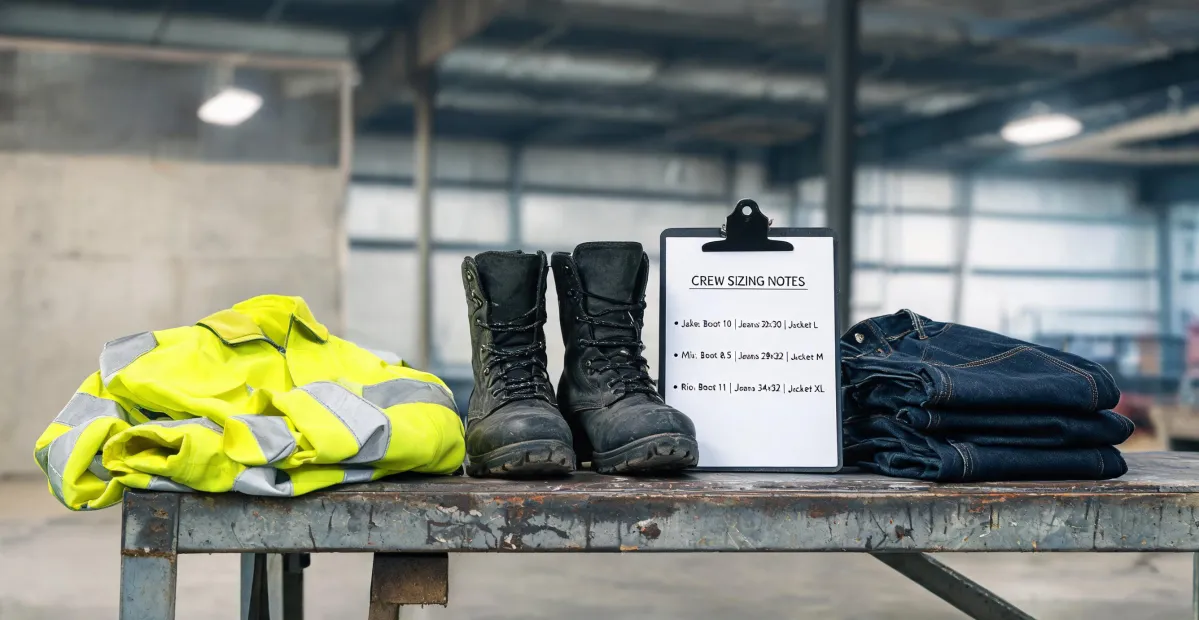
In late spring, I put through the new order: 90 pairs of Ariat boots—the men's composite-toe model plus the women's version—40 Ariat Duralight stretch canvas FR jackets, and half a dozen Keen backups for the wide-foot guys. Total: around $23,000.
Finance called me within the hour. "That's two and a half times what you spent last year."
I don't blame them. It looked bad on a one-page budget summary, even with my spreadsheet of total cost projections.
Even after choosing Ariat, I kept second-guessing. What if the sizing was off? What if the crew rejected them? What if we were back to square one in three months? The four-week lead time felt like a month of Sundays.
Nobody talks about this part: buying better is scary at first.
What Happened After Delivery
The first week, not a single fit complaint. That had literally never happened with any boot order. The women on the crew even came to thank me—which, if you work in procurement, you know is a miracle.
By the end of month one, our safety officer mentioned that the FR jackets were being worn, not hung in lockers. The stretch canvas was why. Guys could bend, reach, and climb without feeling like they were wearing oven mitts. Documentation went in a binder, and site inspections got easier because of it.
We're about ten months into the new program now. Boot-related complaints have dropped by maybe 80%. I don't have hard data on industry-wide averages, but based on our own injury logs, the trips, slips, and "my feet are killing me" sick days have fallen off a cliff.
One small operational detail: we now mail replacement boot laces to out-of-state crews. Per USPS (usps.com), a First-Class Mail large envelope (1 oz) costs $1.50 as of January 2025. It's a $3 fix that prevents a $150 trip to a local store, and it keeps the heel-lock lacing effective across all crews.
The Math That Finally Made Sense
Here's the rough breakdown, since people always ask:
- The $58 boot cost roughly $93 per boot per year once you add replacements, expedited shipping, and admin time spent dealing with complaints.
- The $165 Ariat boot has had zero replacement costs over the first ten months, and the outsoles are still holding up on our harshest site.
- That's roughly a $70 per boot per year swing. Multiply that by 96 pairs, and the "expensive" option is actually saving us around $6,700 a year.
All that made the switch a no-brainer on paper. In practice, it took a failed $58 boot order to get me there.
I'm not saying Ariat is right for every crew. For indoor work on flat floors, a lighter shoe might make more sense. Keen is genuinely better for some foot shapes. The point isn't the brand—it's the total cost of ownership.
The Bottom Line for Anyone Who Buys PPE
If you're a purchasing person under budget pressure—which is basically all of us—here's what I'd tell you: don't buy a product, buy the total outcome.
I now ask three questions for every PPE order:
- Can you show me the compliance documentation? If they can't produce test results at the sales stage, they won't have them at the audit stage.
- What's the warranty, really? Ariat backs their boots. That says something about confidence in the product.
- Will people want to wear this for 8 hours a day? If not, it's a paperweight. A great safety product is one workers don't want to take off.
I still get three bids on every order. I still report to finance. But my budget line item is now called "Total Cost of Foot Protection per Employee per Year." The CFO actually likes that label, because it's honest.
The $58 boot that looked like a win in a spreadsheet was a $1,500 lesson. The $165 boot that looked like an indulgence turned out to be the cheapest thing I buy all year.