-
Most Buyers Focus on Unit Price and Miss What Really Counts
-
When the Spreadsheet Says One Thing and Your Gut Says Another
-
“How Do I Turn a Fire Alarm Off?”—A Question We Can’t Afford to Ignore
-
I Understand the Margins Argument. It’s Still Wrong.
-
Bottom Line: Safety Doesn’t Have a Minimum Order Quantity
In my opinion, the size of your order should never determine the quality of your safety gear. But in my experience, suppliers treat small customers like second-class citizens all the time. That’s not just irritating—it’s dangerous.
I’m the office administrator for a 40-person manufacturing company. I manage all our safety-related purchasing: FR clothing, work boots, safety glasses, fire extinguishers, the whole list. It works out to roughly $60,000 a year across a dozen vendors. When I took over purchasing in 2020, I believed that being a customer meant being valued, regardless of order size. I learned otherwise pretty fast.
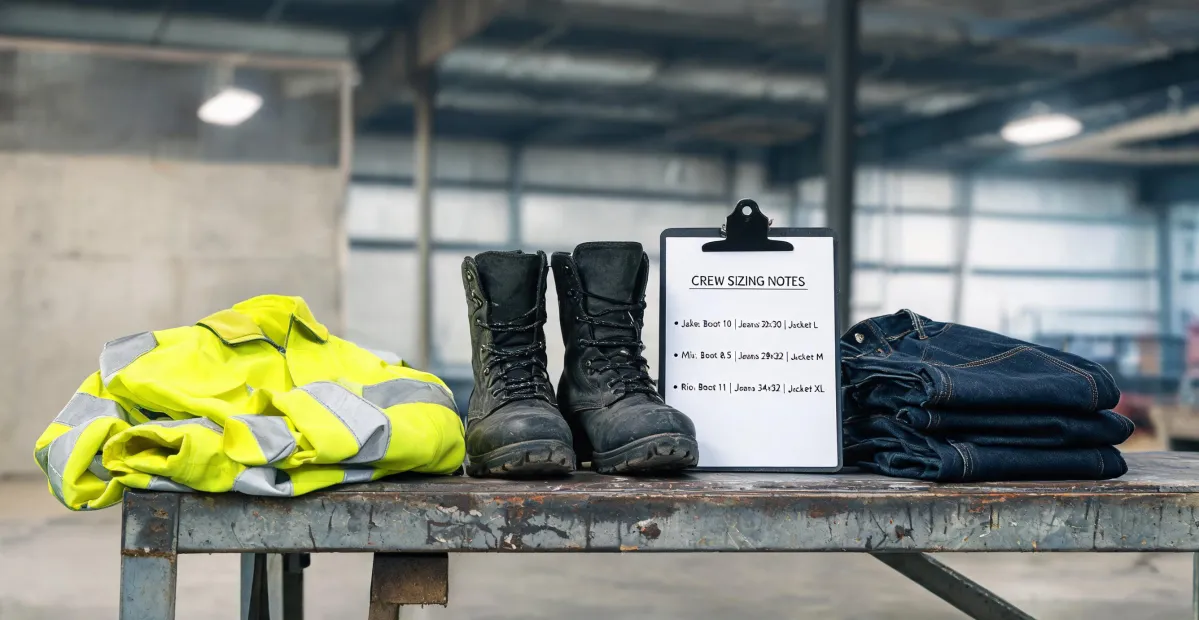
Early on, I called a well-known supplier about ordering ten pairs of men’s work boots. Not a huge order, but not trivial either. The rep laughed and asked if we had a “bigger project” in mind. That was my first clue: if you’re a small buyer, some vendors treat you like a favor instead of a client.
This matters because workplace safety has nothing to do with volume. A three-person repair crew has the same electrical hazards as a fifty-person crew. An employee standing in front of an arc flash doesn’t care whether the company bought five pairs of Ariat FR work pants or five hundred. The gear either protects or it doesn’t.
Most Buyers Focus on Unit Price and Miss What Really Counts
Most buyers focus on per-unit pricing and completely miss the setup fees, freight charges, restocking policies, and the cost of a product failing when it matters. I made this mistake myself in 2022.
I found a deal on “industrial safety glasses” at $3 per pair. That was about a third of what we normally paid for Nemesis safety glasses. I ordered fifty pairs and felt pretty smart about it. Within a month, people started complaining about fogging. Then one pair cracked during a routine grinding task. No major impact, just normal use.
Nobody got hurt, but the cost wasn’t just the $150 I saved. It was credibility. The crew stopped trusting our equipment, and I had to reorder the good stuff anyway. A bigger company with a dedicated safety officer might have caught the problem earlier. I didn’t, because I was wearing three hats and didn’t have a proper verification process.
Now I only buy Nemesis safety glasses. They cost more, but the anti-fog coating lasts, the impact ratings are documented, and the vendor answers questions when I have them. Per FTC guidelines (ftc.gov), claims about product safety have to be truthful and substantiated. But plenty of generic glasses on the market make vague claims with no supporting test data. If you don’t ask, you won’t know.
The same goes for boots. There are a lot of “work-style” boots that look the part but are basically fashion items. A real Ariat men’s work boot comes with a clear safety toe rating, a slip-resistant outsole, and a warranty that means something. Yes, it costs more. But if an employee is on their feet for ten hours, or stepping on sharp debris, a $40 boot is a false economy. Now it’s Ariat or nothing for our team.
And don’t ignore shipping costs. According to USPS (usps.com/stamps), First-Class letter postage rose to $0.73 as of January 2025. That seems tiny, but some suppliers use shipping to punish small orders—a $5 handling fee on a $60 order adds nearly 10% to the cost. On a big order, that disappears. On ours, it’s just an insult. It’s one more way small buyers get treated differently for no good reason.
When the Spreadsheet Says One Thing and Your Gut Says Another
During our 2024 vendor consolidation project, a new supplier came in with an aggressive quote for FR coveralls: about 25% below what we were paying. Finance was excited. The projected savings were around $2,200 a year, which is real money for a company our size.
But something felt off. I asked for third-party test data on their flame-resistant fabric. They sent a glossy brochure with a picture of a torch and a lot of words like “premium protection.” No lot numbers, no lab results, no specific standards listed.
I tried to convince myself I was being paranoid. The numbers were compelling. But my gut said no. We stuck with our regular supplier—the one who provides Ariat FR clothing and actually sends spec sheets when asked.
About a month later, I saw a recall notice for that manufacturer’s FR shirts. The fabric didn’t meet its published arc rating. We weren’t affected, but we came closer than I’d like to admit. That’s when I finally made peace with the tension between data and intuition: a spreadsheet only knows what you put into it. If you don’t include factors like documentation, service, and trust, the cheapest option will always win—until it doesn’t.
I’ll admit that some loyalty to Ariat FR work pants is based on gut. But that gut developed after five years of reading labels, requesting test reports, and seeing what fails in the field. Ariat’s sizing is consistent, the snaps are proper, and the arc rating is printed right on the tag. That level of detail tells me a company respects its customers enough to be transparent—even when the customer is small.
“How Do I Turn a Fire Alarm Off?”—A Question We Can’t Afford to Ignore
Last month, a new hire asked how to turn a fire alarm off. People laughed. I didn’t, because it’s a valid question—especially in a building full of people who’ve only seen fire alarms in movies.
When someone asks that, they’re not announcing a plan to sabotage the system. They’re admitting they don’t know what to do when the alarm goes off. Is it real? Is it a drill? Can they open the panel to silence it? All of that is information we assume people know, but usually nobody tells them.
That question changed how I think about purchasing safety equipment. Gear is only half the equation. Guidance is the other half. These days, I ask every vendor for training materials, not just a quote.
The rep we buy our Ariat boots from sent us videos about proper fit, lace-up methods, and care instructions. The supplier for our Nemesis safety glasses included a maintenance guide and a replacement schedule. It took them ten minutes to hit forward, but it told me they treat small clients like real clients.
The vendor that sold us our fire alarms? Not so much. We called to ask about a low-battery alert, and the response was essentially “we don’t provide technical support.” I get that some suppliers are just resellers, but in a safety context, that answer is unacceptable. Selling a fire alarm without basic guidance is like selling a car without telling the buyer where the steering wheel is.
There was also a moment, not long ago, when I had to make a purchase decision under serious time pressure. A maintenance shutdown was coming, and I had about two hours to confirm an order of FR pants and work boots for a new crew. Normally, I would get two or three quotes and compare delivery times. There was no time. I called our usual vendor and just said yes. That trust doesn’t come from a product catalog—it comes from past experiences like the ones above.
I Understand the Margins Argument. It’s Still Wrong.
Let me be fair: I do get why some suppliers are less excited about a $450 order than a $45,000 order. Procurement costs are real. It takes the same number of phone calls to quote ten pairs of boots as it does to quote fifty. Maybe a small order means less margin for the sales rep. I’m not in their shoes, and I won’t pretend to understand that pressure completely.
But small customers aren’t a wasted trip. They’re a seed. We’ve grown from 12 employees to 40 in four years. Our annual spend has tripled. The suppliers who treated us with respect in 2021 are now getting a bigger share of that budget. The ones who acted like we were inconvenient? They got dropped.
I’ve never once asked a vendor to lose money on an order. I just want the same documentation, availability, and respect that a bigger client would get. If a vendor can’t provide that for a small order, I don’t trust them with a big one anyway.
Bottom Line: Safety Doesn’t Have a Minimum Order Quantity
So here’s where I land: if you manage purchasing for a small company, don’t let anyone make you feel like your employees are worth less just because your order value is lower. You deserve Ariat FR clothing that actually meets standards, work boots that don’t fall apart, and safety glasses that protect under real conditions. You also deserve a vendor who answers your questions—even the awkward ones about turning off a fire alarm.
As USPS proves with its pricing rules, small items still have exact specifications. The postage for a one-ounce letter is $0.73 as of January 2025, no exceptions. Safety gear should be no different: specific standards, specific documentation, no shortcuts.
Real safety doesn’t shrink just because your order is small. And suppliers who figure that out early will win the long game.