-
Step 1: Verify the Standards Before You Start Searching
-
Step 2: Pick the Right Products for the Actual Work
-
Step 3: Choose Your Ordering Channel Wisely
-
Step 4: Nail the Sizing Before You Commit the Budget
-
Step 5: Apply Discounts and Verify the Paper Trail
-
Step 6: Schedule the Maintenance They Always Forget
-
Common Mistakes to Avoid
If you're the person stuck ordering safety gear for other people, this one's for you. I handle purchasing for a 60-person manufacturing company, and my safety equipment orders run somewhere around $40,000 a year across eight vendors. My job is making sure everyone has what they need without blowing the budget and without making finance angry.
This checklist is for when you need to outfit a team with work boots, FR clothing, and the other stuff that keeps a facility compliant. Use it when you're setting up a new vendor, when you're onboarding a new group of employees, or when your current supplier has been making you look bad with late deliveries and wrong sizes. It's six steps. Step 6 is the one that goes into the "I'll handle it next month" pile and then bites you during an audit.
Step 1: Verify the Standards Before You Start Searching
Before you type "moc toe work boots" into a search bar, figure out which standards your workplace actually needs. For most US industrial environments, that's ASTM F2413-18 for protective footwear. But there's a difference between boots that meet the bare minimum impact rating and boots rated for compression as well.
It's tempting to think all "safety toe" boots are basically the same. They're not. The ASTM F2413-18 standard includes multiple ratings, and if your employees work around heavy loads or forklift traffic, you need to know whether you're looking at an I/75 or C/75 rating. Some Ariat work boots carry both ratings, but you should check the specific model's documentation. If a listing says "ASTM F2413-18" and the vendor can't produce a certificate of conformance, that's a red flag. Per FTC guidelines (ftc.gov), product claims must be substantiated, and safety rating claims are no exception. I've had a supplier tell me their boots "met the standard" and then not be able to show me the paperwork. Walk away from that.
Step 2: Pick the Right Products for the Actual Work
Now that you know the standards, think about what your crew is doing all day. The moc toe work boot style is popular because it leaves extra room in the toe box — which matters when someone's on their feet for ten hours. But a warehouse worker and a maintenance mechanic will wear out different boots.
I went back and forth between buying one standard boot for everyone and giving employees a shortlist to pick from. One boot is simpler to manage and reorder. A shortlist makes people happier and fewer employees complain about fit. I chose the shortlist — three Ariat safety-toe options with different widths, plus a budget alternative for employees who don't need the top tier. The two weeks of research up front saved me months of return hassle.
For FR clothing, the Ariat M7 FR jeans are a solid baseline. They're covered by ASTM F1506 requirements as a flame-resistant garment. But before you order, check whether your people work near electrical arc flash hazards. If they do, you need arc-rated clothing, which is a separate category with stricter testing than general FR. The M7 line works for many environments, but it won't cover every job. That distinction is worth taking seriously.
Step 3: Choose Your Ordering Channel Wisely
You'll probably end up on Zappos or Amazon — that's where the volume is. Both sell legitimate safety shoes, but they handle the purchasing experience differently.
Zappos has a better footwear return process. If a pair doesn't fit, the exchange is quick and painless. Amazon is usually better for price comparison across multiple sellers, but you have to be careful. Look at the "Ships from and sold by" line. If it's not a verified distributor, skip it. I've seen listings for work boots that looked legitimate but were third-party products with inconsistent quality claims.
“Here's the thing: I always check who the actual seller is before adding to cart. A counterfeit safety boot isn't just a bad purchase — it's a liability for the employee wearing it.”
Also keep an eye on small order shipping costs. Zappos and Amazon offer free shipping on most boots, but that's not universal for FR jeans or safety accessories. When we order lightweight PPE like safety glasses and gloves from smaller vendors, they often ship via USPS, and First-Class letter rates went up to $0.73 per ounce as of January 2025. It doesn't change our vendor selection by itself, but it's part of the total-cost comparison.
Step 4: Nail the Sizing Before You Commit the Budget
This is where most procurement mistakes happen. People guess their shoe size, or they tell you the size they wore in high school. If you're ordering boots for a crew, get them sized properly. Ask them to use a Brannock device at the safety supply store. It takes two minutes and eliminates the majority of returns.
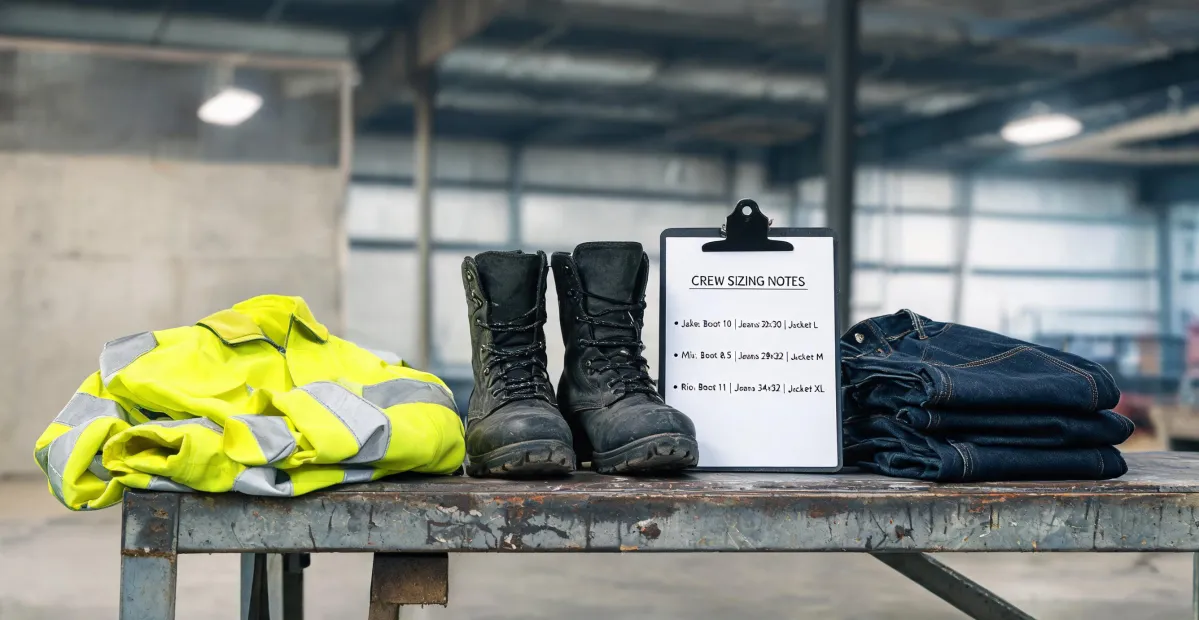
Keep a running spreadsheet with each employee's size, width, and preferred model. I started one in 2022 after ordering eleven pairs of boots and having four come back for exchange. Now I update it every time someone gets fitted. When a new hire joins, I already know what to order in most cases.
And don't forget to buy at least one spare pair in the most common size. When a boot fails or goes missing on a night shift, having a backup saves everyone from a trip to the emergency clinic (which costs way more than a pair of boots). Not ideal, but workable.
Step 5: Apply Discounts and Verify the Paper Trail
If your company qualifies for the Ariat military or law enforcement discount, use it. It's available for veterans and reserves too, and the savings add up when you're buying in bulk.
On the paperwork side: don't pay a vendor who can't produce a proper invoice. I learned this in 2023 when I found a good price on safety glasses from a new supplier and they handed me a handwritten receipt. Finance rejected the expense, and I ate $300 out of my department budget. (Note to self: verify invoicing capability before the first order, not after.)
For every SKU you order, get a certificate of conformance. File it with the invoice. OSHA doesn't care about your relationship with the vendor — they care about the documentation. And if you're buying from a marketplace, save the product page screenshots with the compliance info visible. That paperwork has saved us during two audits so far.
Step 6: Schedule the Maintenance They Always Forget
This is the overlooked step. You ordered the boots, the FR jeans, the safety glasses, and the gloves. But what about the fire extinguishers mounted in your facility?
Fire extinguishers need a visual inspection monthly and a professional maintenance check every year, per NFPA 10. If your facility is like ours, the extinguishers get ignored until someone walks by and notices the tag is outdated. I had to scramble during a company safety walkthrough when I realized our extinguishers were weeks past their annual inspection. Had two days to schedule inspections before the safety consultant arrived. Normally I'd compare three vendors, but there was no time — I went with the first licensed company that could fit us in. Turned out fine, but the extra cost was on me.
When you search "where to get a fire extinguisher inspection near me," look for a company with certified technicians and verifiable licenses. They'll tag each unit with the inspection date and give you a service report. Keep those reports in the same compliance folder as your certificates of conformance. Set a recurring calendar reminder so this doesn't sneak up on you again. I now have a quarterly reminder to check extinguisher tags across our three locations, and it's been two years without a compliance gap.
Common Mistakes to Avoid
Three things I still see people get wrong:
- Buying by price alone. The cheapest boot that meets the standard feels like a win until an employee gets hurt and the boot wasn't actually fit for the hazard. Total cost includes your time fixing fit issues and the risk of noncompliance.
- Confusing FR and arc-rated. Flame-resistant doesn't automatically mean arc-rated. If your employees work around electrical hazards, verify the arc rating before you order. It's a different set of standards and a different level of protection.
- Letting fire extinguisher inspections slide. It's a separate service with a separate invoice, so it's easy to treat as optional. It's not optional. Put it on the calendar and make it part of the same purchasing cycle as everything else.
At the end of the day, this is a process. The first time you walk through all six steps, it feels like a lot. By the second or third cycle, it's just how you work. And having a checklist means you don't have to keep all of it in your head — which, for me at least, was the whole point.