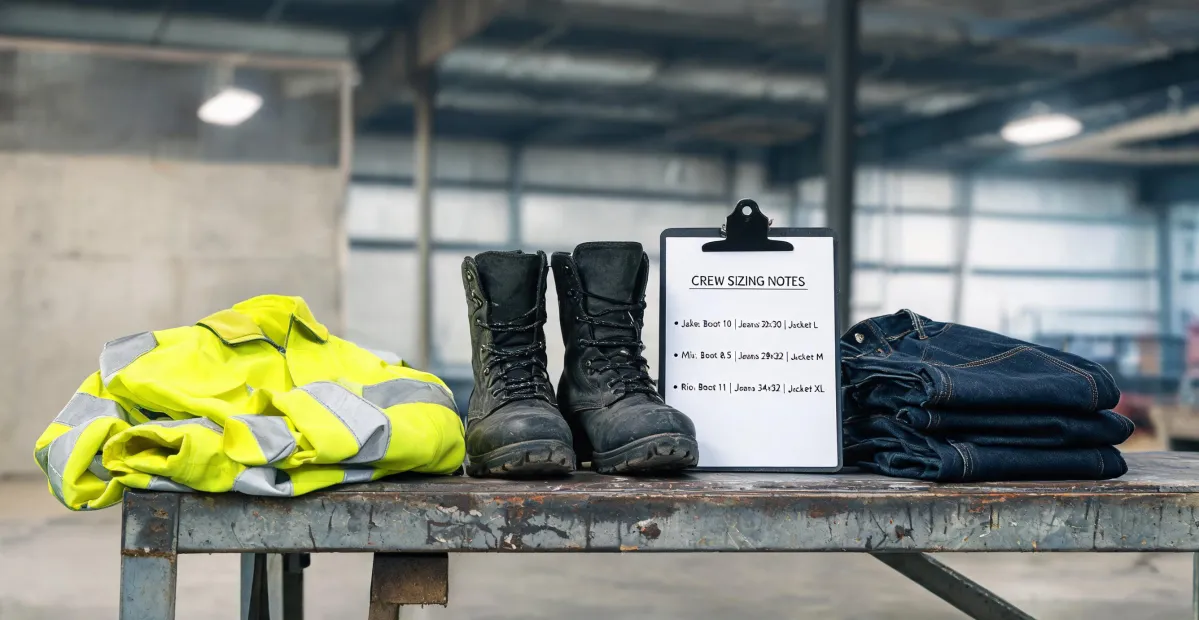
I've been the office administrator here for six years, which means I'm the one who handles about 80 safety-related POs a year. Our team has about 400 people across three locations, and I report to both operations and finance. A big chunk of that budget goes through the Ariat brand shop—Ariat work boots, FR shirts, and other PPE. When operations asked me to review our boot program for 2025, they didn't ask for a list. They asked for a comparison: Ariat Rambler work boots, Chelsea work boots, and BOA work boots. And while I was at it, someone in the warehouse wanted to know if the nitrile gloves we stock are latex free.
I compare work boots the way I compare vendors: fit and daily use, safety compliance, and total cost including returns. That's the framework I used here.
Fit and Daily Wear: Rambler vs. Chelsea vs. BOA
Rambler is the classic lace-up that we've ordered more than any other boot. It gives a locked-in feel around the heel and enough room in the toe for long days. The tradeoff is break-in. Most of our crew says two weeks of sore calves, though I might be misremembering—some say a week.
Chelsea boots are the ones people don't expect. They have no laces, so workers slip them on and off quickly. For anybody who walks between offices, warehouses, and client sites, that convenience matters. But the fit is looser around the ankle. If someone needs maximum heel hold, a Chelsea can feel unstable.
BOA boots surprised me. The dial closure lets a worker tighten or loosen with a twist, even with gloves on. I expected it to be a novelty. The shock was that our older warehouse guys preferred it once they used it for a week—no laces to untie, no re-lacing after lunch, and no trip hazard from a loose lace.
The other underrated issue is how a boot fits into a locker or a truck, not just on the floor. Chelsea boots make sense for quick changes. BOA boots make sense for people who are constantly adjusting during the day. Ramblers are for people who only take boots off at the end of the shift.
My honest take: fit is personal. But if I'm comparing first-day satisfaction, the BOA wins. If I'm comparing durability at the lowest cost over two years, the Rambler is still a strong choice.
Safety Compliance: The Part That Keeps Me Up at Night
I've learned to ask 'what's NOT included' before 'what's the price.' With boots, that means asking whether the exact SKU has an ASTM F2413 safety-toe rating. As of March 2025, that's the standard I use for impact and compression protection. But not every boot in a line has that rating. A nice-looking Chelsea boot might lack the rating, while a Rambler work boot with a composite toe has it.
Don't assume a style name means protection. The same model name can come in a non-safety version and a composite-toe version. I've learned to look for the raised marker on the shaft or the tag inside, not just the product title. If workers are around live circuits, I also check for an EH rating.
That's why I now pull a spec sheet from the Ariat brand shop and save it with the PO. I still kick myself for the time I ordered a stack of FR shirts based on color and feel, not the NFPA 70E label. We had to return fifteen shirts because they weren't arc-rated for the job. The shirt fabric looked fine. The rating wasn't.
Per NFPA 70E (2024 edition), an employer is responsible for ensuring that clothing worn by workers protects against the hazard. Verify current requirements at the official NFPA source before making a decision.
Are Nitrile Gloves Latex Free? Yes—Here's the Real Question
Whenever I put out a purchase order for gloves, someone asks, 'are nitrile gloves latex free?' Yes. Nitrile gloves are made from synthetic rubber, not natural rubber latex. So for a worker with a latex allergy, switching to nitrile eliminates that allergen.
The comparison that matters more is nitrile vs. latex for the specific task. Nitrile resists many chemicals, punctures more slowly than latex, and doesn't trigger the same Type I latex allergy as natural rubber. Latex gloves offer better tactile sensitivity, which is why some medical and lab teams still want them. But latex can cause allergic reactions, and the proteins in natural rubber are the reason many companies go nitrile for general use.
Just check the label. Not every 'exam glove' is latex-free, and not every nitrile glove is powder-free. If you need a certified latex-free glove for medical or food handling, check for FDA-cleared labeling and ASTM D6319. Verify current requirements at the FDA and ASTM websites.
Total Cost and the Return Loop
Boot price is only the first number. Total cost includes shipping, return shipping, and the hours I spend chasing wrong sizes. In 2023, I knew I should have double-checked the size spread before ordering 24 pairs of Ramblers, but I thought 'it's the same mix as last time.' That was the one time it wasn't. Seven pairs didn't fit, and we lost about $140 in return shipping plus a week of stocking gaps.
That's when I started comparing by total cost. A BOA model can cost more per boot—as of Q1 2025, roughly 10-15% more than an equivalent Chelsea in our invoices—but it can lower return costs because the dial adjusts fit better. Verify current pricing at the Ariat brand shop before relying on that range. The transparent vendor who lists all fees upfront, even if the total looks higher, is usually the cheaper one.
I also learned to be specific about time. I once asked a vendor to send 'as soon as possible.' They heard 'whenever convenient.' The result was a delivery two weeks later than I expected. Now I put 'must arrive by [date]' in every PO.
So Which Ariat Boot Should You Order?
Here's the short version, based on what works for our team:
- Choose Ariat Rambler work boots if your crew is used to lace-ups, wants a proven leather upper, and has a few days for break-in.
- Choose Chelsea work boots if workers need to take boots on and off quickly and don't need maximum ankle lock.
- Choose BOA work boots if you want the fewest fit complaints, easier adjustment with gloves, and no laces to trip on.
If I had to standardize our field team today, I'd order BOA composite-toe boots. For the sales and office people who spend an hour on the floor, Chelsea is the practical pick. The Rambler stays on my list for employees who specifically ask for a classic lace-up.
And yes, order the nitrile gloves. They're latex-free, they're easier on allergic workers, and they save you the second guessing. Don't skip the label check, though. The right product only counts if the paperwork actually says what you need.
There's something satisfying about handing a new hire a pair of boots that fits on the first day. It makes the spreadsheets worth it.