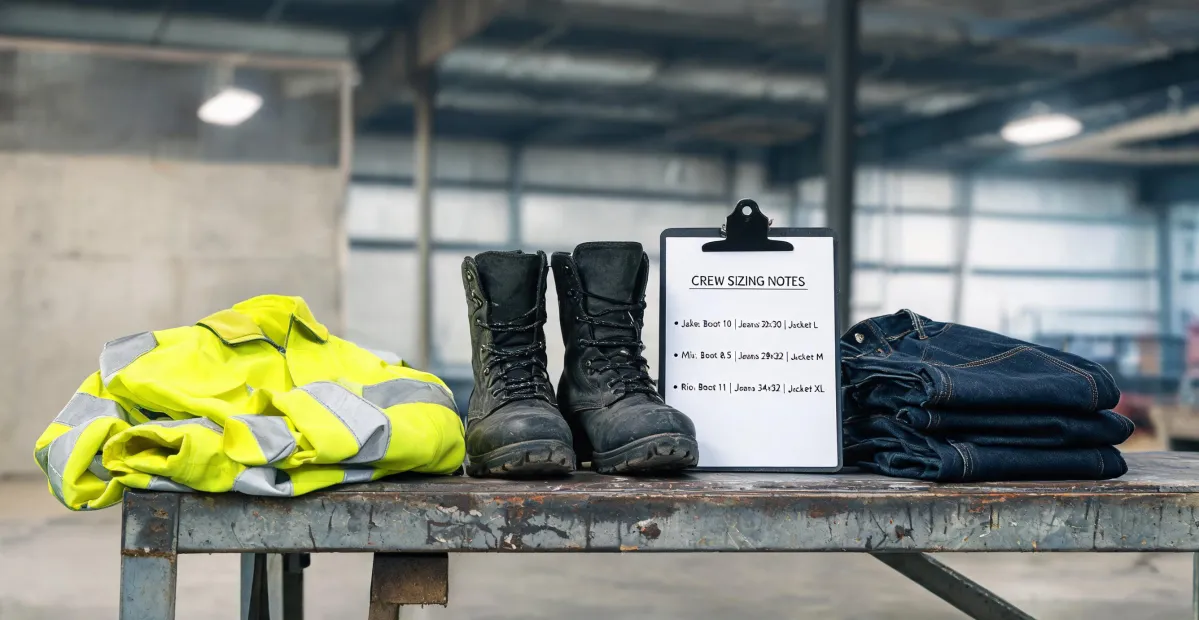
I'm the person who takes the call when a safety manager needs 30 pairs of FR jeans by tomorrow morning. It happens more than you'd think. Last March, a plant manager phoned me at 3:45 PM—35 pairs of FR denim needed by 7 AM for an auditor's visit. We split the order across three vendors, sent two couriers across town, and ate about $200 in shipping charges. The jeans passed inspection.
But the real problem didn't start that afternoon. It started weeks earlier, when someone searched "work jeans" instead of checking the actual FR rating on the label. The jeans showed up, they looked right, and nobody read the tag until the audit was already on the calendar.
That's the story I keep in mind when people ask me about safety workwear. After a few hundred emergency orders, I've stopped recommending a universal "best" setup. There isn't one. There's the right gear for your specific work conditions, and there's everything else.
Here's how I sort the requests that come through my desk.
The Four Work Scenarios That Determine Your Gear
If you can place your crew in one of these four scenarios (or a combination of two), the product decisions get a lot clearer. The scenarios: hot work and electrical environments, heavy construction and general industry, chemical or dust-heavy environments, and work with overhead hazards. Each one changes the priority list.
Scenario 1: Arc Flash, Welding Sparks, and Flash Fire — Start With FR Clothing
Electricians, welders, and anyone working near energized panels need flame-resistant clothing. Not heavy cotton. FR garments that meet NFPA 2112 standards.
The most common failure I see is a crew that's well-prepped on top and unprotected below. Someone wears an FR shirt but regular denim jeans, because regular jeans are "thick enough." Regular cotton will ignite and keep burning in a flash fire. That's not a risk worth taking for the sake of $20 per employee.
Ariat's FR jeans M4 is a useful reference point. It's an 11.5-ounce FR denim with a straight fit. The interesting part is that the weight is low for the category—and that's actually a feature. Heavier FR jeans meet the same standards, but they're hot. In summer months, workers leave them in their lockers. The M4 is light enough that it gets worn. And that's the whole game with safety gear. It only protects you if it's on your body.
If you're inspecting FR garments, check the label. NFPA 2112 should be stated outright. Then check the zipper, buttons, and thread. I've seen "FR" jeans with non-FR polyester zippers—which melt in the exact scenario they're supposed to survive.
Scenario 2: General Construction, Loading Docks, and Concrete Floors — Boots and Durable Workwear
For crews whose main hazards are slips, falls, and fatigue, footwear and base layer come first.
The Ariat Groundbreaker is my go-to recommendation for the "on their feet ten hours a day" crowd. It uses Goodyear welt construction, so the sole can be replaced when the tread wears instead of tossing the entire boot. The outsole holds up on wet concrete, and the composite toe version doesn't turn into an icebox the way steel toes do in winter.
I've learned to ask about electrical hazards before recommending any boot. The Groundbreaker comes in an EH-rated version for crews working near live equipment. Basic work boots don't automatically include that rating, and it's not obvious from looking at them.
On the workwear side, Schmidt workwear comes up more and more in our orders. Their double-front pants and canvas shirts hold up well against abrasion, they're breathable for a base layer, and the pocket layouts make sense for carrying hand tools. I bring them up because of a broader point: if your crew doesn't need FR, don't pay the FR premium. Heavy-duty workwear at a regular price still leaves budget for the boots—which are the piece that actually connects you to the ground.
Scenario 3: Chemicals, Spray, and Dust — Coveralls
Paint shops, chemical handling, grain facilities, demolition—coveralls are the right outer layer. But "coveralls" covers a lot of ground, and knowing the difference can prevent a bad incident.
A standard disposable coverall (the Tyvek-style white suit) is made to keep dust and dry particles off the worker. It is not chemical splash protection. If your workers handle liquid chemicals, you need a coverall with a documented breakthrough time rating for those specific chemicals. ASTM F739 is the test standard to look for. And if there's a fire risk on top of the chemical risk, you need FR-rated coveralls as well. That's a specific product category, not a marketing tag.
The other failure mode is the suit that gets abandoned mid-shift. Hot, stiff coveralls hang in the gang box after day one. I've pushed clients toward breathable coveralls with better cuts, even if it costs a few dollars more per unit.
PPE that doesn't get worn isn't PPE. It's decoration.
Scenario 4: Overhead and Side Impact — Safety Helmet vs. Hard Hat
This is the question I get most often lately, and the honest answer is: it depends on the hazard.
ANSI Z89.1 sorts them out. Type 1 helmets are tested for impacts to the top of the head. Type 2 helmets are additionally tested for lateral impacts. And there are electrical classes—Class C means no electrical protection, Class G is rated up to 2,200 volts, and Class E is rated up to 20,000 volts.
A traditional Type 1 hard hat is still a reasonable choice when falling objects are the primary concern. They're lighter, cheaper, and ventilate better. But they tend to come off when a worker leans forward or bends over. That's tolerable on flat ground. It's not tolerable on a sloped roof or in a confined space.
That's where the newer-style safety helmets earn their keep. Chin straps keep them in place, and Type 2 lateral protection matters when a worker could hit their head sideways against a beam or structure. If the crew works at height regularly, a safety helmet is worth the upgrade. If they only pass under suspended loads occasionally, a properly fitted hard hat is fine. And don't buy bump caps thinking they're in this category—bump caps protect against stationary low ceilings, not falling objects. They won't handle the impact.
How to Determine Which Scenario You're In
I'm not a safety engineer, so I'll stop short of telling you how to run your hazard assessment. What I can tell you from the supply side is which patterns produce the most emergency calls.
Spend twenty minutes walking the floor. Look for:
- Arc flash labels and energized panels—FR clothing is non-negotiable. Something like the Ariat FR jeans M4 becomes a baseline item, and your training should line up with NFPA 70E.
- Loading docks, concrete floors, uneven terrain—boots are the critical item. The Groundbreaker's EH version covers the electrical angle, and the composite toe handles the impact side.
- Spray cans, chemical containers, visible dust—coverall specs get specific. Match the garment to the chemical, not to the supply closet.
- Work at height, scaffolds, sloped surfaces—this is where the safety helmet vs. hard hat question resolves itself. Chin straps and lateral protection win the day.
Then build the system bottom-up: boots, base layer (FR or heavy-duty workwear depending on the hazard), outer layer (coveralls when needed), and head protection matched to what's above.
And whatever you buy, put a replacement schedule on it. FR clothing degrades with washing. Hard hats have a service life printed inside the shell. Boots lose slip resistance as the tread wears. The gear that protected your crew two years ago might not be protecting anyone today.
I process enough emergency orders to know that gear bought from a generic checklist is how safety managers end up in a 4 PM panic. Do the walkthrough first, pick the right gear for the work you actually do, and you won't need the panic order at all.