-
Use this checklist when...
-
The 7-Step Purchasing Checklist
-
1. Start with the hazard, not the brand
-
2. Calculate total cost, not the tag price
-
3. Don't assume unisex sizing covers your crew
-
4. Read the FR label like your audit depends on it
-
5. Pick safety vests by exposure class
-
6. Hearing protection: know what 'works' means
-
7. Use your buying power, even when your order is small
-
1. Start with the hazard, not the brand
- Common mistakes I've made so you don't have to
-
Bottom line
Use this checklist when...
This is for small to mid-size companies buying PPE for real jobs, not for a corporate procurement team with dedicated ergonomists. I manage PPE purchasing for a 35-person electrical crew, and our annual safety equipment budget sits around $40,000. That's not a huge number, but it's enough to make a dent if you buy the wrong thing.
Use this when you're replacing worn-out FR clothing, adding a new crew member, or setting up a safety program from scratch. It's not a complete compliance guide. It's the practical buying sequence that has kept our costs in line without getting anyone hurt. There are seven steps.
The 7-Step Purchasing Checklist
1. Start with the hazard, not the brand
When someone asks for Ariat in the first sentence, I get it. A lot of crews like Ariat work boots because they're comfortable and hold up. But a brand is not a specification. The right move is to write down the hazard first: drop hazards, puncture risk, electrical exposure, slippery surfaces. Then look for the standard that covers it. OSHA's PPE rule, 29 CFR 1910.132, already requires you to assess hazards before choosing equipment. That's not a suggestion.
For example, if an electrician needs a boot that handles both rough terrain and live circuits, you want an ASTM F2413-18 rated boot with an electrical hazard rating. Many Ariat work boots have that rating, but not all of them. Same brand, different models, different safety jobs.
Three things matter in a boot order: the standard, the fit, and the lead time. Checkpoint: before you get prices, you should be able to say 'we need EH-rated, ASTM F2413-18 boots' or something equally specific. If you can't, you're shopping too early.
2. Calculate total cost, not the tag price
I learned this the hard way in Q4 2024. One supplier quoted $125 per pair of work boots. Another quoted $88 per pair. On paper, the second one was a no-brainer. But the cheaper supplier added $18 per pair for shipping on small orders, required a minimum order of 12 pairs, and had a six-week lead time. We needed eight pairs in ten days. The 'cheap' option would have cost us more in overtime and rental gear.
What I mean is total cost of ownership is a simple equation: price + shipping + replacement frequency + the cost of getting it wrong. A $125 boot that lasts 18 months is cheaper than an $88 boot that lasts six months, even before you factor in an employee stuck in a bad-fitting pair for a full shift. I keep a spreadsheet for every style: purchase date, days worn per week, and replacement reason. Shipping cost and lead time can be a deal-breaker.
Checkpoint: if a supplier can't give you the lead time and return policy in writing, that's a red flag.
3. Don't assume unisex sizing covers your crew
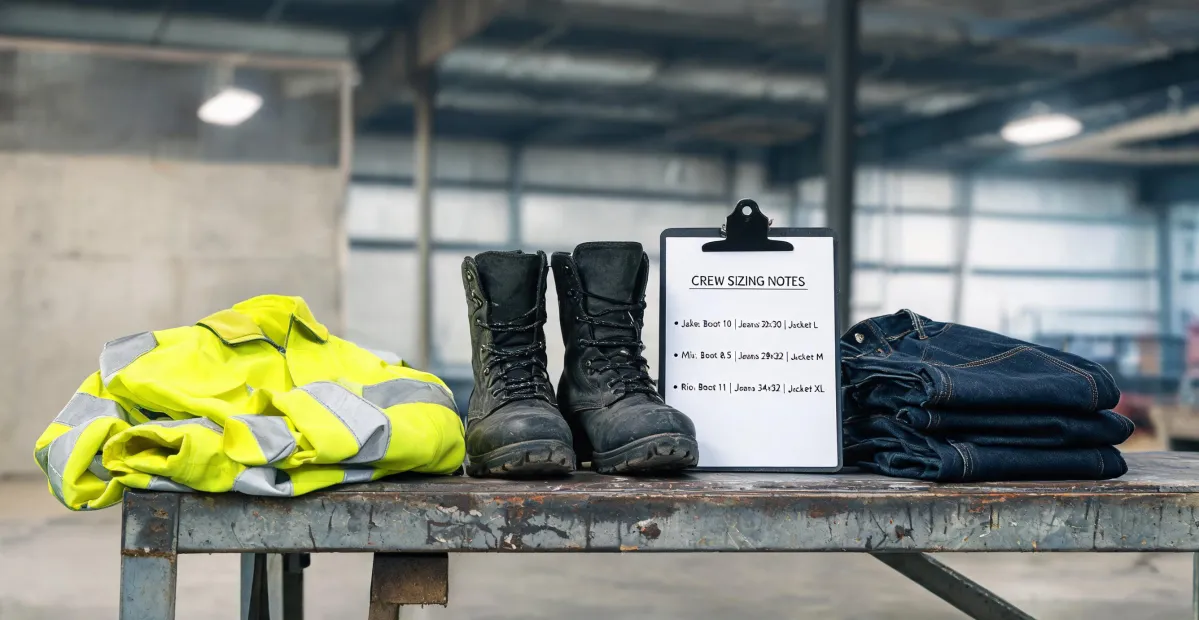
This is one of those assumptions that can mess up an order. I assumed we could order women's Ariat work boots by going one size down from men's. Didn't verify. Turned out the women's line has a different shape, not just a different size label: narrower heel, more room in the toe box, different shaft height.
If you have women on your crew, look at the Ariat work boots women's line and let them try on a couple of widths. It's not about being generous; it's about safety. A boot that doesn't fit gets adjusted with 'creative' modifications, and that's how accidents happen.
Checkpoint: order two sizes for every new boot style and let the crew test them before you place the bulk order.
4. Read the FR label like your audit depends on it
FR clothing is not a category you can guess on. For arc flash work, you need the right arc rating. NFPA 70E uses categories to simplify that, and Cat 2 is common because it covers many electrical tasks without making people wear a full suit.
Ariat Cat 2 jeans are a good example. They're arc-rated for Category 2 work, which means an ATPV of at least 8 cal/cm2. But if you order the 'FR' version of another brand and assume the same number, you might be wrong. Check the label on every lot. Yes, every lot. Fabric suppliers can change the weave or finish, and the label is the only place you'll see the current rating.
For full coverage, Carhartt coveralls are a solid option for cold weather and for quick-on/quick-off situations. But not all Carhartt coveralls are arc-rated. Some are flame-resistant for flash fire hazards, some aren't rated for electricity at all. The label has to say what you need. If it doesn't, keep looking.
Checkpoint: when FR clothing arrives, spot-check the label on at least one item from each box before you hand it out.
5. Pick safety vests by exposure class
A safety vest looks simple, but there's a reason ANSI/ISEA 107 defines performance classes. If workers are on a highway shoulder with traffic moving fast, a Class 2 vest is usually not enough. You'd want Class 3, which has more reflective material and higher visibility.
We bought one batch of 'hi-vis' vests without checking the class and ended up with a full box of Class 1 vests that were useless for the project. That was a $900 lesson in reading the label. Now every project spec includes the class number, and we match the vest to the exposure.
Checkpoint: know the difference between background material, reflective material, and the class required by your contract.
6. Hearing protection: know what 'works' means
Every once in a while, someone on the crew asks 'how does Loop earplugs work?' Especially the younger folks who use them off the job. The short version: they have a small internal channel and filter that reduces the sharpest sounds while keeping speech easier to understand. That makes them nice for concerts or focus. But they're not the same as a standard foam plug.
For industrial use, the key number is NRR, or noise reduction rating. A 33 NRR foam plug and a lower-NRR filtered plug are not interchangeable. The filtered plug might feel better, but it won't protect the same way in a loud environment. If you want comfortable options, give employees a small list of approved earplugs with the NRR stated, and let them choose within that list. It costs almost nothing and improves compliance.
Checkpoint: if you can't find the NRR on the package, don't buy it.
7. Use your buying power, even when your order is small
I'm not going to pretend that a $500 PPE order gets the same attention as a $50,000 one. But the suppliers who treated our small orders seriously early on are the ones we've stuck with now that we spend more. If a supplier won't answer questions because your quantity is small, find another one. Today's sample order can become next year's contract.
It also pays to ask about discount programs. Ariat has military and law enforcement discount programs, for example. If any of your principals or employees qualify, those discounts can add up on boots and FR clothing. The worst thing they can say is no.
Checkpoint: every quote should include freight, payment terms, and estimated lead time. If a vendor doesn't offer that in writing, they're not really quoting you.
Common mistakes I've made so you don't have to
Mistake 1: Treating all 'FR' as the same thing
Not all FR clothing is equal. A pair of Ariat Cat 2 jeans is arc-rated. A basic FR shirt might not be. A pair of Carhartt coveralls might be flame-resistant but not rated for arc exposure. If you mix them, verify each piece meets the hazard. Don't assume the word 'FR' on the label means the same thing.
Mistake 2: Forgetting the return process
Even after choosing a new boot supplier, I kept second-guessing. What if the quality changed between the sample and the full batch? The two weeks until delivery were stressful. The boots were fine, but I hadn't checked the return policy. When we then had to return two damaged pairs, the email chain took a week. If a return process isn't simple, your total cost just went up.
Mistake 3: Ordering for an 'average' person
Safety gear is not one-size-fits-all. If your crew includes women, order the Ariat work boots women's line in actual women's sizes. If someone is on the shorter side, order a safety vest in M, not L. Trying to make one size stretch across a whole crew is a safety problem and a cost problem.
Bottom line
The goal is not to buy the cheapest PPE. It's to buy the right protection once, track what it costs, and stop surprises in the next budget cycle. Use these steps, verify the standards, and remember that good suppliers exist for small customers too.
Quotes and price examples in this article came from Q4 2024 vendor conversations. Verify current pricing and specs before you place a large order.