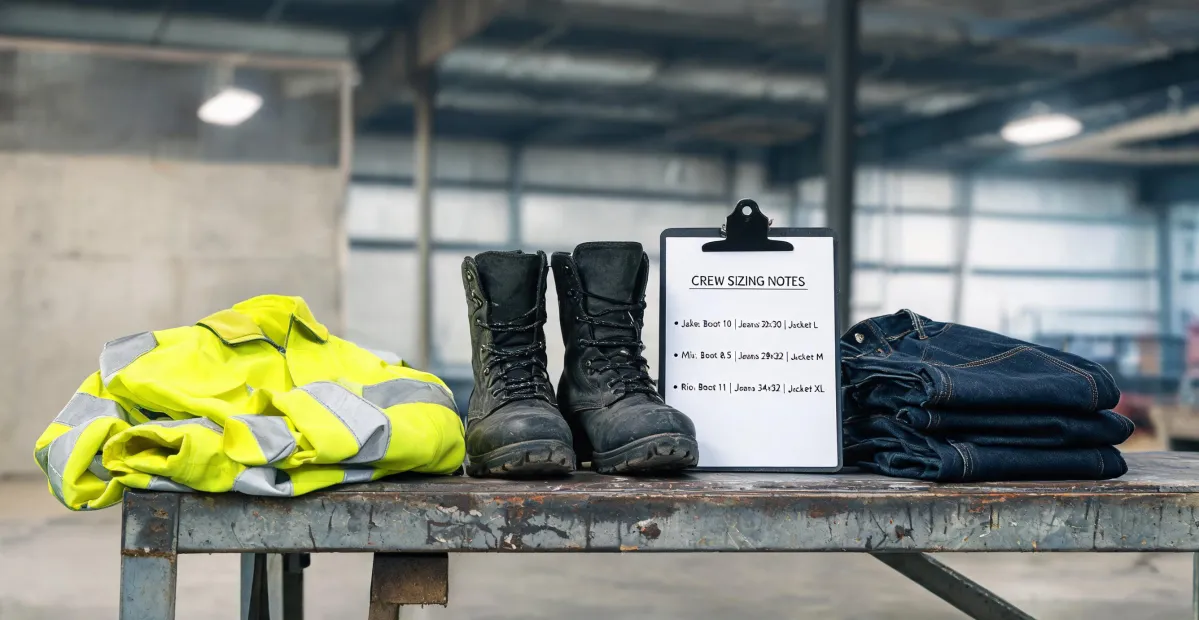
I'm the office administrator for a mid-sized manufacturing company. I manage all the safety equipment purchasing—FR workwear, steel toe boots, safety glasses, gloves, fire extinguishers, even the perimeter fence. About 400 employees across three locations, roughly $150,000 in purchase orders annually, and I report to both operations and finance. That's a long way of saying: if it keeps a worker safe at our facility, I'm the one who orders it.
If you're reading this because you've typed something like 'ariat fr jeans' or 'steel toe work boots' into a search bar and are comparing options right now, I understand what you're doing. I was in the same place four years ago. Here's what I learned the hard way: the cheapest gear that meets the standard is only cheap if people actually wear it. If they don't, you've spent 100% of the money for 0% of the protection.
The Surface Problem: Check the Spec, Place the Order
When I took over purchasing in 2020, I treated safety gear like any other supply order. Need FR jeans? Verify NFPA 70E / ASTM F1506 compliance. Need arc-rated work shirts? Compare arc ratings, compare prices, order. Need steel toe boots? Confirm ASTM F2413 rating, pick the lowest bid. I was managing eight different vendors at the time, and my system was simple: find a compliant product at the best price, keep the spreadsheet updated, and move on to the next order.
On paper, that system worked beautifully. We passed audits. I had documentation for everything. If an inspector walked in, I could prove compliance in under five minutes. But then came March 2023, and a quiet conversation with our maintenance supervisor changed how I think about the whole thing.
The Deeper Problem: The Gear That Nobody Wants to Wear
There had been an arc flash near-miss on the production line. One of our electricians was standing within two meters when it happened. He wasn't wearing his FR shirt.
My first reaction was frustration. We'd provided him with everything he needed. Then my supervisor explained why the shirt was in the locker instead of on his back. The FR shirts we'd been buying from our low-bid vendor were stiff, heavy, and didn't breathe. In summer heat, wearing one for a full shift was genuinely uncomfortable. The electrician had made a calculated choice that morning, and it was the wrong one—but he never should have had to make that choice in the first place.
We talked to more crews over the following weeks, and the same story kept coming back. The FR jeans felt like cardboard. The boots pinched after two hours. People wore the gear when safety walked by, then swapped back as soon as the coast was clear. I should add that this wasn't a handful of picky employees—it was nearly unanimous across the teams.
Here's the part that really stung. Around that same time, our facilities team spent almost an entire meeting debating the color of a property manager's preferred black aluminum fence for the parking lot perimeter. Thirty minutes on shade and finish. And in that same month, nobody had asked a single worker whether the safety gear was comfortable enough to wear. We put more thought into a fence than into the clothing that could prevent serious burns.
We were treating safety as a procurement checkbox, not as a human behavior challenge. Those are two completely different things.
That realization sent me down a path of asking better questions. It also started me on a very expensive education about what 'compliant but unworn' really costs.
The Price of 'Good Enough'
Let me put actual numbers on this, because that's what finally got finance to pay attention.
Footwear cost us over $3,500. In 2021, I ordered 60 pairs of steel toe boots from a low-bid vendor. ASTM F2413 compliant, spec sheet perfect, nobody comfortable. Fourteen pairs came back with sole damage within three months, and a steady stream of workers complained about aching feet. We also tested a batch of Nike steel toe shoes, requested by some of the younger warehouse crew. Those worked better for lighter tasks—the brand name meant people actually wanted to wear them—but they weren't the right fit for everyone. The toe box ran narrow, and workers on concrete all day found them tiring after six hours.
The result? I spent roughly $3,500 on boots that were returned, replaced, or retired early. Not counting the hours spent processing returns and reorders.
The FR workwear gap was harder to quantify but far more dangerous. The near-miss in March 2023 could have been a serious injury. When I escalated the incident, my VP asked a simple question I couldn't answer: 'Do we actually know how many of our people are wearing this stuff?' I knew what we'd purchased. I had no idea what was being worn. That gap between procurement and practice is, in my opinion, the most dangerous blind spot any safety program can have.
And then there was the fire extinguisher incident. A forklift bumped one of our ABC extinguishers and discharged dry chemical powder across a storage bay. Nobody on site knew how to clean fire extinguisher powder. We stood around with our phones, looking it up mid-emergency. What we learned: ABC powder is corrosive when it sits on metal, and the right way to clean it is to vacuum the bulk first—HEPA if you have one—then wipe down with a mix of 50% isopropyl alcohol and 50% water, wearing gloves and ventilating the area. Never use compressed air, because it just blasts the powder into the air and spreads the residue further.
We learned that on day three, after the powder had sat on two pieces of equipment. The corrosion repair bill: about $900.
Add it all up—boots, FR clothing nobody wore, equipment damage, labor hours—and I count roughly $6,000 in direct waste over the 2021–2023 period. But the potential bill was much higher. A single arc flash injury could easily be a six-figure incident, and our management team couldn't answer the most basic question about whether our safety gear was actually being used.
What I Do Now Instead
I don't have a perfect system, but I've made changes that have cut waste and narrowed the gap between orders and reality.
- Pilot test before bulk purchase. Every major safety gear order now goes through a two-to-three-week trial with a group of workers who actually do the job. Their feedback is blunt, and it's worth more than any spec sheet.
- I switched FR workwear based on that feedback. Our pilot groups consistently chose Ariat. Workers told us the Ariat FR jeans were more breathable and flexible than anything else we tested, and the Ariat FR work shirts drew the same reaction—people actually wear them through a full shift. Not because a compliance matrix said so, but because they feel better. Since the switch, the 'left in the locker' problem has essentially disappeared.
- I brought facility safety into the same system. The fire extinguisher powder lesson turned into a one-page cleanup guide posted at every extinguisher station, plus a $60 cleanup kit stocked in the maintenance closet. And the black aluminum fence finally got approved—once we shifted the discussion to gate security and crash resistance, which mattered more than the finish.
- I track usage, not just purchases. Once a quarter, I walk the floor without a clipboard and just look at what people are wearing. It's the most honest safety metric I've found.
Bottom Line
If you're the person who buys safety gear for your company—20 people or 400, it doesn't matter—please learn this faster than I did: compliant doesn't equal worn, and unworn gear is just expensive decoration.
This was all accurate as of early 2025. FR fabric technology and boot designs keep improving, so double-check current products before you commit. But the process will always hold: let your people try the gear, listen to what they say, and measure what actually gets worn.
Trust me on this one. I paid $6,000 for the lesson.