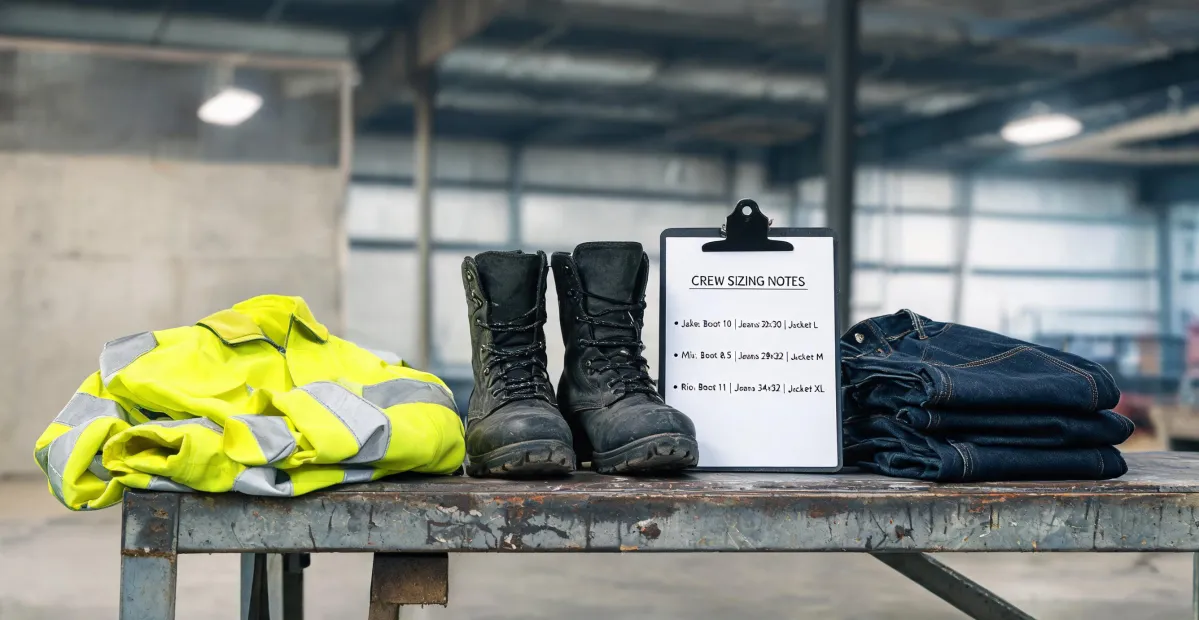
When the Deadline Smells Like Jet Fuel
I don't even need to check the date to remember this one. July 2024. A client called at 3:47 PM on a Thursday needing 22 pairs of work boots — Ariat, specifically — for a crew that was flying to a refinery turnaround the following Tuesday. Normal turnaround for custom-sized, ANSI-rated boots? 5 to 8 business days, if the distributor has stock. These guys had 96 hours to receive, fit, and break in the boots. And they hadn't ordered yet.
In my role coordinating PPE for industrial projects, I've handled 47 rush orders in the last quarter alone, and we pushed 95% of those out on time. But this one was different. Here's why.
The Fork in the Road
We could go local. But I don't know a single local boot shop that carries 22 pairs of Ariat work boots in 11 different sizes — including half-sizes and wide widths — on a Friday morning. Or we could go generic. But generic FR-rated boots? The crew needed NFPA 70E compliance, and the client already had a brand preference. The procurement manager literally said, 'If I bring out a boot that doesn't say Ariat on the tongue, those guys will complain for six weeks. Just get the good ones.'
The third option: pay a premium for guaranteed delivery from a national safety distributor with a direct-to-client air freight option. Price tag: $400 extra in rush fees on top of the $1,800 base cost. The client's alternative if we chose wrong: miss the Tuesday gate check, costing them a $15,000 project fee. So we paid the premium. You can probably guess how this turns out, but the real lesson is in the details.
The Boot Break-In Problem Nobody Talks About
Once the boots arrived (Friday morning, 8:00 AM — talk about cutting it close), I realized we had a second deadline: breaking in the boots. The crew was flying out Sunday night. That gave each guy roughly 48 hours to wear those new Ariat boots in. I don't know how many of you have tried breaking in a pair of Ariat FR jackets or Hi-Vis gear — they're tough by design. The leather upper on the work boots takes deliberate wear.
Seriously, the 'how to break in work boots' advice you see online — 'just wear them around the house' — isn't practical for a 22-man crew. We did a speed break-in clinic: heavy socks, heat gun on the leather (carefully, 15 seconds per panel), and a forced march around the warehouse for 90 minutes. I know, it sounds ridiculous. But nobody ended up with blisters on Day 1 of the shutdown. So that worked.
What I Learned About 'Rush' vs. 'Certainty'
Here's the thing. The same week, a different company asked about Danner tactical boots for a similar project. They went with a local distributor because they were $75 cheaper per pair. The boots showed up Monday morning — the shift started Monday at 5:00 AM. Crew worked 12 hours in boots that weren't broken in. Two guys developed plantar fasciitis within a week. Was the $75 discount worth that? I doubt it.
This worked for me, but our situation was an emergency turnaround for a compliant crew with a strict brand preference. Your mileage may vary if you're buying for a warehouse team that can break boots in over two weeks, or if your site supervisor doesn't care about brand. So take this with a grain of salt: paying for speed only makes sense when the cost of not having the boots on time is higher than the rush fee itself.
The Brand-Name Factor
I can only speak to domestic operations here. But in my experience, Ariat Hi-Vis FR outerwear and the standard Ariat work boots hold up better in petroleum environments than a lot of off-brand options. They're designed with composite toe that doesn't get cold in winter, which matters when you're standing on a concrete pad for 10 hours. And their FR jackets — tested to ASTM F1506 — have a reputation for not shrinking in the first wash. That matters for a crew that lives in those jackets for a 14-day turnaround cycle.
Now, about the Ariat FR jacket itself: I've personally worn one on-site in 45-degree weather with a moderate wind, and it held up. Not too bulky, which is key for climbing ladders or working in tight valve assemblies. But don't take my word for it. The real test is the autoclave test. Most shops don't have that, so I rely on the documentation. Also, the Ariat Hi-Vis line meets ANSI Class 3 — which is required for highway construction and many industrial settings. So that's not fluff; that's compliance.
Standard & Compliance Minutiae
This is an area where I see a lot of confusion. For example, hard hats are required to meet ANSI Z89.1 Type I Class E for electrical protection up to 20,000 volts. That standard isn't just a suggestion — it's a federal requirement under 29 CFR 1910.135. I've seen quick-service vendors sell 'safety-rated' helmets that claim compliance but have no stamp. That's a citations risk, full stop.
Also, color matching in safety gear is supposed to follow the Pantone Matching System for high-visibility fabrics. But Pantone colors don't always translate to fabric. For instance, Pantone 267 C (a standard dark blue for FR uniforms) has no exact CMYK equivalent, and matching it on different fabrics can result in Delta E deviations. That's a big deal if your client has a brand guide they enforce.
The Bottom Line
If you're an industrial safety buyer, here's the pattern I've seen: projects that go wrong start with a decision that saves $200 on delivery or $50 on a jacket. The projects that succeed budget for certainty. I'm not saying overnight shipping is always right. But I am saying that the regret of paying an extra $400 fades in about six hours. The regret of missing a deadline because you tried to save money? That sticks with you for a lot longer.
Oh, and one more thing: if you're searching for 'work boots near me' at 4:00 PM on a Friday, you're already three steps behind. How to break in work boots in 48 hours? Heat gun, heavy socks, and 90 minutes of walking. But the best way is still to order them a week early and wear them to the office. Just saying.
Pricing references: based on publicly listed distributor fees for domestic air freight, January 2025. For NFPA 70E compliance standards, see NFPA 70E-2024, Section 130.7(C)(1).