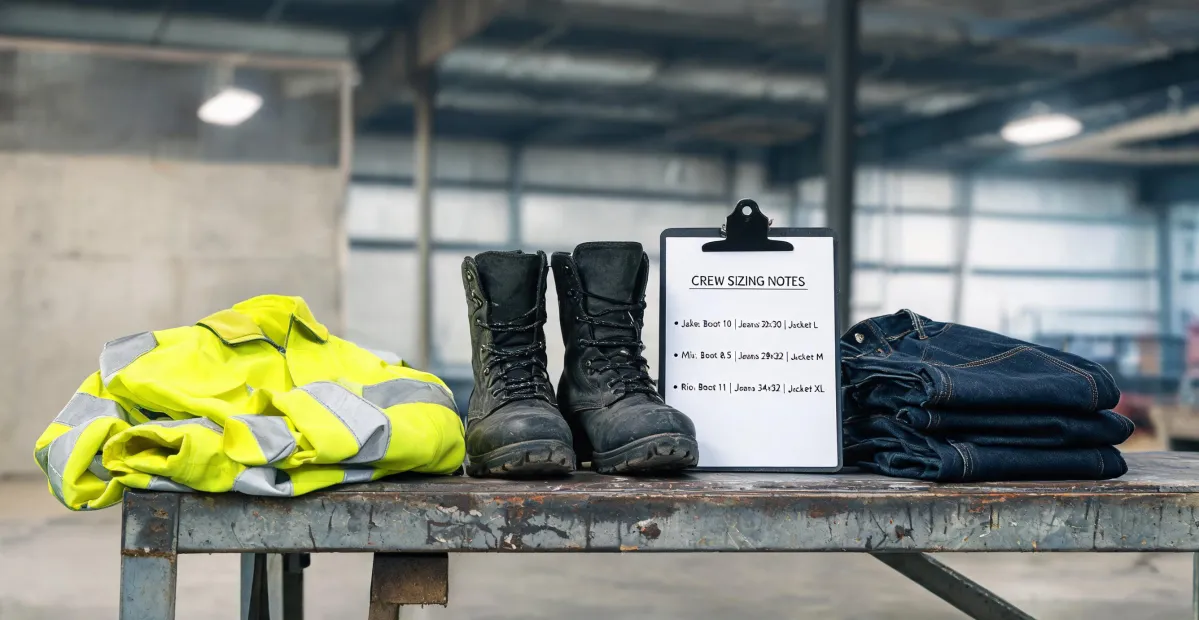
Here's an unpopular opinion for anyone who orders safety gear for a crew: the cheapest work boots, FR clothing, and PPE on the market are the most expensive things you can buy.
I know that sounds like a sales pitch. It isn't. I have the receipts—literally. I've been handling equipment and safety supply orders for our team since 2017, and in that time I've personally made and documented enough mistakes to fill a training manual. Roughly $3,200 of my company's budget went to lessons I should have learned sooner.
Let me show you what I did wrong, and what it cost us.
When I started, I chased the lowest price like it was my job
My first year, I assumed the smartest thing I could do for our budget was find the cheapest safety-toe boots and FR clothing that met spec. I'd compare three online vendors, pick the bottom price, and submit the order. Seemed professional. Seemed responsible.
Turned out I was building a maintenance nightmare on a spreadsheet that looked good.
Here's the boot math, because that's where the problem started.
We were paying $60 to $80 for budget safety-toe boots. In the warehouse, they felt fine. On real job sites? Three to four months, and we were ordering replacements. Soles delaminated, stitching blew out, toe caps compressed. I remember one guy walking around in boots held together with tape because he didn't want to ask for another pair.
Meanwhile, a few crew members who had bought their own Ariat work boots were getting 12 to 18 months out of a single pair, and one heavy-equipment operator pushed his past two years. That's not brand loyalty—that's durability. Publicly listed pricing for work boots as of January 2025 puts a solid pair of Ariat work boots for men in the $170–200 range, while the budget tier sits around $60–80. Rates change, so verify current prices before you assume.
Do the math:
- $70 budget boots × 4 pairs per year = $280 per year
- $185 Ariat boots × 1 pair per year = $185 per year
That's a 34% annual savings from buying the more expensive boot. Before factoring in the hours spent ordering, restocking, and managing complaints.
But honestly, the money was the least important part. In September 2022, one of our guys took a glancing strike from a steel beam. He was wearing budget boots. The toe cap had already compressed from months of wear, and the sole had no puncture rating to speak of. He ended up with a broken toe and a week off. The medical paperwork alone ate more than three years' worth of boot savings.
The crew bought their own boots after that. I don't blame them.
FR clothing: where the cheap option gets dangerous
Here's something I didn't understand early on: not all flame-resistant clothing is equal. The price gap usually reflects what you can't see.
In early 2023, we found a supplier offering FR shirts at roughly 35% below our usual rate. The samples felt fine—decent weight, proper labels, ASTM F1506 listed on the tag. I submitted a bulk order. Who wouldn't? That kind of saving makes any procurement person look good.
Then our testing lab pulled pieces from the shipment and found inconsistent arc ratings across the batch. Some shirts met spec. Some didn't. The entire order got quarantined. 47 shirts. $2,300. Into the reject pile.
That's when I stopped buying FR clothing on price and started buying it on trust. We now order through a distributor that carries established brands, including Ariat's FR line, and I verify ASTM F1506 compliance before I commit. The premium over budget brands has narrowed to 10–15% anyway. That premium buys consistent arc ratings and seams that still look right after fifty washes.
I'd rather pay for certainty than explain to a safety auditor why the paperwork says one thing and the fabric says another.
The five-minute fix that saved us hundreds per quarter
Now let's talk about earplugs.
We issue reusable earplugs to the shop floor—the kind with the flexible loops and replaceable silicone tips. They run about $25–$35 a pair, which sounds minor until you multiply it by forty people and add the pairs that get "lost" (they don't).
I used to treat them as disposable. Then one of our veteran safety supervisors pulled me aside and showed me how to clean loop earplugs properly.
How to clean loop earplugs (it takes five minutes)
- Pull the silicone tips off the earplugs.
- Rinse them under warm running water.
- Wash them with a drop of mild dish soap. No alcohol, no solvents, no boiling water.
- Dry them completely, then snap them back onto the loops.
We posted a laminated one-pager in the break room, told the crew we'd replace earplugs only when they were actually broken, and watched our hearing-protection spending drop by about 60% the next quarter.
Why does this belong in a conversation about boots and FR clothing? Because it's the same principle from the other direction: total cost includes maintenance. A $30 pair of earplugs that gets cleaned lasts eight months. A $10 pair that gets thrown out every three weeks becomes the expensive option. Same logic applies to boots that get brushed, cleaned, and reconditioned—they last twice as long as boots that never get any attention.
What about Danner, Georgia, or other boots?
I hear the question coming: "Aren't you just trying to sell Ariat?"
No. I care about the category, not the logo. Some of our guys swear by Danner tactical boots for long days on concrete, and I can't argue with their results. Others have been happy with Georgia work boots, which have a solid reputation at a slightly lower price point. We've got both on the team right now, side by side with Ariat.
The point was never "this one brand is the only option." It's that the cheapest unproven option is a gamble where you're betting with your crew's feet and your safety budget. Quality boots—whatever the brand—are built with better materials and proper construction. That's why I now insist on working with a store that actually stocks Ariat boots and other proven brands, so people can try them on. Fit matters more than the name on the heel.
But what if the budget genuinely isn't there?
I understand. Budget pressure is real, and the CFO won't approve a 30% increase because one person wrote an article about value.
So let me be honest about the boundaries of this argument.
There are items where the cheap version is fine. Disposable gloves. Basic safety glasses. First-aid supplies. Buy whatever the budget allows. I'm not saying premium everything is always the answer.
But for gear that protects people and has to survive daily abuse—boots, FR clothing, hearing protection—the math flips. A $200 boot that lasts 18 months costs less than an $80 boot that lasts four. A correctly rated FR shirt costs nothing when it works, and everything when it doesn't. Earplugs that get cleaned instead of replaced are nearly free.
If you truly can't afford the better option today, make a phased plan. Prioritize the highest-risk roles first. Replace worn gear before it fails. And stop treating the purchase price as the only number that matters.
The spreadsheet that changed how I buy
Sometime in 2024, I started tracking every major equipment purchase in a simple spreadsheet with four columns:
- Purchase price
- Lifespan
- Maintenance cost
- Cost of failure
Nothing fancy. But it changed how our team buys.
We've caught 47 potential errors with our pre-purchase checklist in the past 18 months—wrong specs, missing certifications, inflated delivery promises. Not because I'm brilliant. Because I paid the tuition: a $2,300 reject pile, a broken toe that could have been worse, and more wasted budget than I'd like to admit.
So here's my advice, from someone who literally burned budget to learn this:
Stop buying the cheapest thing. Start buying the thing that will still be working—and still be compliant—when the next budget cycle rolls around.
The lowest quote on work boots looks responsible in a board meeting. It looks a lot less responsible in an incident report.
I had to learn that the hard way. You don't.