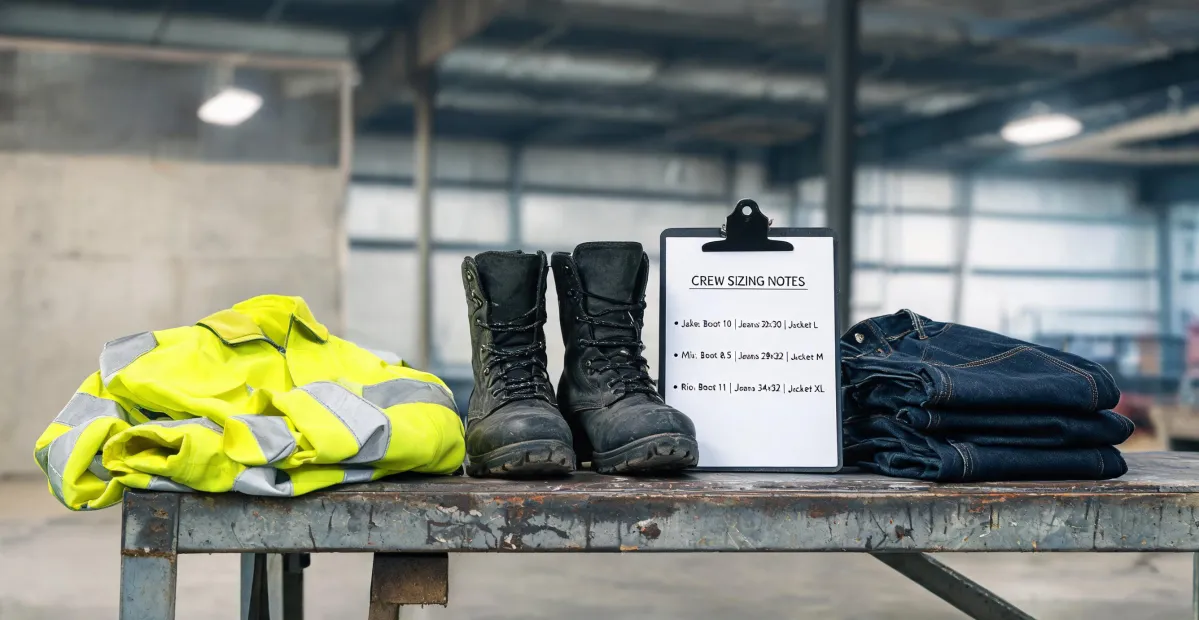
Let me start with what I'm not: I'm not a safety consultant, and I don't work for Ariat or any equipment supplier. I'm the office administrator for a mid-sized industrial services company. We have about 400 employees across three locations, and I manage the part of purchasing that covers work boots, FR clothing, fire extinguisher maintenance, and gloves. In a normal year, that means 80-plus orders and roughly $180,000 in safety-related expenses.
If you've ever had a supervisor forward a link to the exact boot the crew wants and ask, “Why can't we buy these?” you know the dance. The quote is higher than the line item in the budget. Someone suggests a cheaper substitute. The decision gets measured by money saved on the invoice instead of by how long the gear actually lasts.
My most recent version of this involved the Ariat lace up steel toe boots a maintenance crew asked for, a generic boot that was about $14 less per pair, and one question nobody could answer: “How long will these last in our environment?”
The real issue is never the boot itself
The problem underneath the product request is not whether a brand name deserves a premium. It is whether we are looking at the unit price or at the total cost of owning and using a piece of safety gear. That total includes fit, durability, and the consequences of early failure. It is hard to put that on a purchase order, but ignoring it doesn't make it disappear.
A purchase order is not a safety program. Price is what you pay on the invoice. Cost is what you pay after the gear has been through a week of real work.
The vendor who sends a clean all-in proposal—line items, fees, delivery, tags, documentation—might not win the “lowest price” game. In my experience, that vendor almost always wins the final invoice game. I've learned to ask “what's NOT included” before I ask “what's the price.”
Why the second invoice never shows up in the bid comparison
When I first took over this role, I compared safety quotes the way you would compare paper clips. For paper clips, the risk is low. For safety gear, the risk is a worker who stops wearing a boot because it hurts, an FR shirt that doesn't perform, or a fire extinguisher service visit with no record. Those costs come later, and they don't have a line item on the original order.
Here is a concrete example from 2023. I approved a budget steel-toe boot because the spec sheet checked the right box. Six weeks later, a worker's sole split. He taped the boot and went back to work because he didn't want to be a problem. The supervisor caught it, we reordered the boot he should have had in the first place, and the rush shipping wiped out every penny we saved. What I mean is, the savings weren't savings. They were deferred costs with extra steps.
Standards get you to the starting line
This is why I now start with standards before price. Our PPE hazard assessment and OSHA's general PPE requirements in 29 CFR 1910.132 tell me what the job requires. Boots need to meet ASTM F2413 for impact and compression. Arc-rated or flame-resistant clothing has its own standards, like NFPA 2112 or ASTM F1506, depending on the hazard. Fire extinguisher work follows NFPA 10. I don't have to be the authority on every standard, but the vendor should be. If a supplier can't name the standard or show me the documentation, that's a deal-breaker.
That said, standards don't create comfort. A boot can pass every test and still be wrong for a worker on concrete for ten hours. That's why we test samples now. A pair of Ariat Men's Rebar Lift 8″ waterproof work boots made the rounds in our building recently, and the feedback surprised me. Guys who usually hate waterproof boots said the toe box didn't pinch, and the lace-up shaft kept out rain. That told me more than any spec sheet.
Fire extinguisher service, winter gloves, and the “fit” question
Real talk: there are three questions I keep answering, so let me answer them in plain terms.
First, the phrase “fire extinguisher service near me” shows up in our office at least once a year. Near matters, but proximity isn't proof. A service company has to arrive on a schedule, follow an established maintenance procedure, and leave documentation that an inspector can read. In 2022, we used a vendor with good response time and weak paperwork. We had paid for the service, but when records were requested, we had no chain of proof. Now I ask: Who is the technician? What do they leave on the extinguisher? What records do I get before payment?
Second, “are leather gloves good for winter?” is a real question. Leather blocks wind and holds up well on dry jobs, but it isn't waterproof on its own. For wet, cold work, you need an insulated waterproof shell or a leather glove with a liner underneath. One “winter glove” for every task is the same mistake as ordering one boot size for everyone.
Third, the “Keen work boots” request usually comes from someone with wider feet. I don't fight it. Keen offers legitimate work boots, and if they fit better and meet the standard, they belong on the approved list. In our fleet, the Ariat lace up steel toe boots get great feedback when they fit. When they don't, I want another brand in the conversation. Fit is part of the safety function.
The math that changed how I buy
Here is the calculation I wish someone had shown me earlier. A $90 boot that lasts six months costs $15 a month. A $210 boot that lasts two years costs $8.75 a month. The more expensive boot also saves the hours I spend on reorders, returns, and the awkward meeting after an employee shows up in taped-up boots. In our environment, the higher-priced pair was cheaper by months of use. That isn't an industry study. It's my spreadsheet.
Since I started tracking that number, I stopped asking which boot is cheaper and started asking which boot is cheaper per safe wearing month. Those are different questions.
What I do now
I know this all sounds like a lot of process. But it's mostly discipline:
- Name the hazard first. OSHA's PPE standard still shapes how I buy. Once I know the hazard, I look for the standard that applies.
- Test the product before buying in bulk. If workers won't wear it, the standard doesn't matter.
- Compare all-in line items, not just the headline number. That is where hidden fees live. A quote with no detail and one low total is a red flag.
- Keep a durability and paperwork log. When a reorder is requested, I check how long the last product lasted and what the vendor actually delivered. That history beats any sales pitch.
If a company qualifies for Ariat's military or law enforcement discount, I bring it up during the budget conversation. It doesn't change the safety requirement, but it can close the gap between the boot that meets the standard and the boot that a worker will actually wear.
Bottom line: I used to think choosing safety equipment was mainly a price negotiation. Now I know better. The real question is whether a product will keep working—and keep being worn—after the invoice is filed. That is the number I check first. Trust me on this one; I've paid for this lesson out of a department budget I was supposed to be saving.