-
Where This Checklist Came From
-
Step 1: Start With the Hazard, Not the Brand Name
- Step 2: Turn the Request Into a Spec, Not a Model Number
-
Step 3: Calculate Cost per Worker-Day, Not Unit Price
-
Step 4: Ask for the Marks, Test Reports, and Marketing Claims Separately
-
Step 5: Run a Field Test Before You Scale Up
-
Step 6: Plan Size Ranges and a Return Cushion
-
Step 7: Build the Replacement Calendar Into the Budget
-
Common Mistakes I Still See (and One I Made Repeatedly)
Where This Checklist Came From
I buy PPE for a regional electrical contractor. We have roughly 90 field employees, and the annual budget for work boots, FR clothing, and safety eyewear runs around $140,000. That figure surprised me when I first inherited it.
I started out treating every order as a one-off transaction. A project manager would ask for 'the usual' boots, I would approve the invoice, and three weeks later we would find the wrong size range or the wrong protection rating waiting on the dock. This checklist has seven steps. It does not replace the site-specific hazard assessment your safety manager needs. It does keep me from making the same purchase mistake twice.
Step 1: Start With the Hazard, Not the Brand Name
It sounds painfully obvious. Stick with me. A hazard assessment means a written decision, not a general feeling that the job is normal. OSHA's PPE standard at 29 CFR 1910.132 says the employer has to verify the assessment is done, and I have found that document is the fastest way to settle disagreements about what to buy.
Here is why this matters for the buying decision. I get more requests for Ariat moc toe work boots than almost any other style around here. The moc toe look is popular, and some of those models are genuinely comfortable. But if the task involves heavy materials overhead or dropped tools, the boot has to meet ASTM F2413-18 impact and compression requirements. If the task is near live electrical equipment, it also needs an EH rating. Neither of those is visible from a product photo.
The same logic applies to other PPE:
- For eye protection, identify whether the hazard is impact, splash, dust, or arc flash. OSHA expects industrial eye protection to meet the ANSI/ISEA Z87.1 standard, which is why the marking matters more than the frame color.
- For clothing, know whether the hazard is arc flash or flash fire. Arc-rated clothing is tested differently than generic FR clothing, and the distinction affects both cost and safety.
I don't compare boot models or safety glasses until the hazard assessment is signed. That one rule eliminated most of our expensive returns.
Step 2: Turn the Request Into a Spec, Not a Model Number
'I need the men's work boots Ariat, size 11.' I hear that every spring. What I mean is, they know the brand and the size, but nobody has written down the protection requirement. A brand name is a shortcut, not a specification. A purchase order full of model numbers is only as good as the person who typed them, and when that person leaves, you inherit the invoice without knowing why.
Before we send an order, each category has a written spec:
- Work boots: leather upper, 6-inch height, ASTM F2413-18 rated toe, puncture-resistant plate if needed, EH rating where electrical hazards exist, insulated or non-insulated depending on season.
- Safety eyewear: ANSI/ISEA Z87.1 high impact, with side shields if there is flying debris.
- FR clothing: an arc rating in cal/cm2 that meets the hazard assessment for the task, not just a tag that says 'FR.'
This is also where the difference between overalls and coveralls shows up on a purchase order.
The Difference Between Overalls and Coveralls (When You're Buying FR)
I used to think the words were interchangeable. They are not. Coveralls are a one-piece garment that covers the torso, arms, and legs, typically worn over your regular clothes. Bib overalls cover the legs and lower torso but leave the upper back and arms exposed; they are the style with shoulder straps and a bib front.
The practical difference for an FR purchase is arm and shoulder coverage. On a task with an arc flash hazard, a plain pair of cotton overalls will not provide arc protection. An FR-rated bib overall can be worn over an FR shirt, and the whole ensemble has to be treated as a system. But if the incident energy analysis says the arms need protection, a coverall gives you that coverage in one garment, while bib overalls alone do not.
I should add that arc rating is not a property of the style. Check the label or the manufacturer's test report for the arc rating rather than assuming the fabric name is enough.
Step 3: Calculate Cost per Worker-Day, Not Unit Price
I have sat in meetings where someone pulls the cheapest work boot off the distributor's price sheet and announces we will save $25 per person. From experience, that is a mistake. The cost that matters is the total cost per worker over a year.
Here is the math I run in our procurement spreadsheet. If a $130 boot lasts six months, the cost is $260 per year. A $190 boot that lasts twelve months costs less over the year and saves two replacement transactions. Multiply that by 60 workers, and the cheaper boot costs us about $4,200 more per year. I'm not saying every budget-priced boot fails early. But that is the risk you are taking with your eyes open.
The budget option also has a hidden cost: complaints. The most frustrating part is not the invoice. It is the ten emails from workers who don't want to wear something uncomfortable for ten hours. If they stop wearing compliant gear, you have a safety problem that no discount fixes. Comfort is part of compliance, whether we like it or not.
Step 4: Ask for the Marks, Test Reports, and Marketing Claims Separately
Certification is not a vibe. For safety glasses, the standard thing to look for is the Z87+ marking on the frame or lens, which indicates high-impact protection under ANSI/ISEA Z87.1. If the glasses don't have that marking, they don't get issued, no matter how good they look.
A foreman once asked me to order the Nemesis safety glasses for his crew because they had a foam gasket and he liked how they sealed against dust. I sent the order with the model name and nothing else. What arrived did not have the Z87+ marking. The supplier's website said 'impact resistant,' which sounds reassuring but is not a compliant marking.
What I learned: put the marking requirement on the purchase order and ask the distributor for the manufacturer's certificate of conformance. The same applies to FR clothing. Ask for the arc rating and the supporting test report. Under FTC advertising guidance, product claims need to be truthful and substantiated (ftc.gov), but a marketing description is not evidence of compliance. I don't care how confident the sales rep sounds.
Should mention: this applies to boots too. A catalog line that says 'heavy duty work boot' tells you nothing. The ASTM F2413 marking inside the boot is what our safety manager checks at delivery.
Step 5: Run a Field Test Before You Scale Up
If you're ordering more than a handful of new boots or glasses, get samples and let workers test them on the actual job. Not at a desk. On the job. A boot that feels fine at 9 a.m. in the office can create a hot spot by 2 p.m. on concrete.
I knew I was supposed to do this. One year I skipped it because the project schedule was tight and the distributor promised the model was the same as last year with a slight update. What are the odds, right? The odds caught up with me. The updated boot ran narrow, 14 pairs came back within 17 days, and we paid a restocking fee on top of the logistics headache.
Now the checklist says: two or three workers from different size groups wear the sample for at least five full shifts. Then we collect their feedback in writing and order the full run. Sometimes this works in favor of a lower-cost option. A composite-toe model from the DeWalt work boots line won over two of our apprentices because it was light enough for a full day on ladders. The marking was compliant. The field test settled the rest.
Step 6: Plan Size Ranges and a Return Cushion
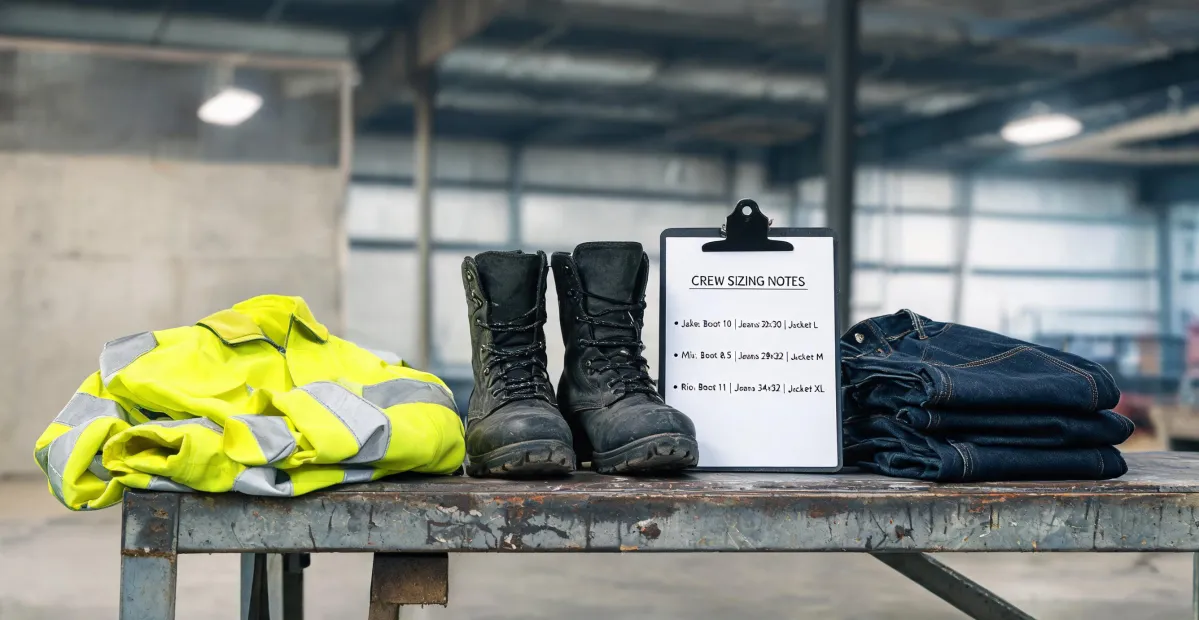
When a new hire writes 'men's work boots Ariat, 11 wide' on the uniform request, I know exactly what they mean. It still doesn't complete our size matrix. Most crews have more size variance than you'd expect. Our list runs from size 6 all the way to 16, and about a quarter of the crew needs a wide width.
Another piece that should be obvious: don't build in zero overstock. We used to order exactly to headcount. The week after boots landed, someone quit, someone else moved to a job that required EH-rated boots, and a delivery driver wore a hole in an outsole. That meant a second order with handling fees and waiting time.
Now we order 8 to 10 percent extra in the most common sizes and confirm the return policy in writing. A worker who gets the wrong size is not a crisis when the invoice allows a swap.
I should mention that moc-toe styles are popular partly because the toe box is wider. Ariat moc toe work boots are a frequent request for that reason. But the brand only covers part of the fit picture. Some feet still need an EE width, even in a wide-toe design.
Step 7: Build the Replacement Calendar Into the Budget
PPE wears out. If you budget only for new hires and incidentals, you'll get a surprise when FR clothing in a hot work group needs replacing all at once. When I look back at several years of orders in our tracking system, the pattern is always the same: replacements come in waves. Without a calendar, you get waves.
Actionwise, I keep a record for each crew and PPE category covering how many units were issued, the issue date, and the expected lifecycle. FR gear is the easiest to forget because it doesn't look worn until a seam fails or fabric gets contaminated. Safety eyewear gets replaced when scratched or damaged, up to a set annual allowance per person.
Record keeping also pays off outside the budget. OSHA requires a documented hazard assessment under 29 CFR 1910.132(d). Our purchasing records show which level of protection each crew was using, and that is the kind of evidence you want if an auditor shows up. It also prevents the 'we always ordered X' conversation from turning into a whole novel.
Common Mistakes I Still See (and One I Made Repeatedly)
The worst purchasing habit is comparing sticker prices without comparing how long the gear lasts or how much administrative work it creates. That low-quote mindset has cost us more in returns and rushed reorders than it ever saved in unit price.
The mistake I made repeatedly was not logging what we ordered and why. The third time we ordered the wrong quantity of FR coveralls, I finally created a verification checklist. Now receiving staff records style, size, and marked ratings into our system before shipments go to the crew.
And on terminology: if you're not sure whether your crew needs overalls or coveralls, look at the arms. Overalls stop at the shoulders. Coveralls run to the wrists.
None of this is academic. A good PPE program should feel boring: same spec, same sizes, same suppliers, same review date. Boring is cheaper.