-
When This Checklist Applies – And Why It Matters
-
Step 1: Lock Down Your Final Specs (Don't Assume You Know Them)
-
Step 2: Build a Timeline Backwards – From Required Delivery to Order Placement
- Step 3: Ask for Rush Options – But Compare Before You Click
-
Step 4: Ensure Your Backup Isn't Worse Than the Problem
-
Bonus: What Most People Forget (And It Costs Them)
-
Final Thought: The Small Order Is Not the Enemy
When This Checklist Applies – And Why It Matters
This is for you if: you're responsible for outfitting a crew or yourself with safety gear—Ariat FR hoodies, FR cargo pants, work boots, gloves, safety glasses, even fire extinguishers or smoke alarms—and you just realized you're way behind schedule.
Maybe a project deadline got moved up. Maybe you're onboarding last-minute crew. Or maybe (like me, more than once) you simply dropped the ball and need to fix it.
In my role coordinating safety equipment for industrial clients, I've handled over 60 rush orders in the last three years—some with turnaround windows as tight as 36 hours. Here's the 4-step checklist I use when time is not a luxury.
Step 1: Lock Down Your Final Specs (Don't Assume You Know Them)
First instinct: call your supplier and say "I need everything." Bad move.
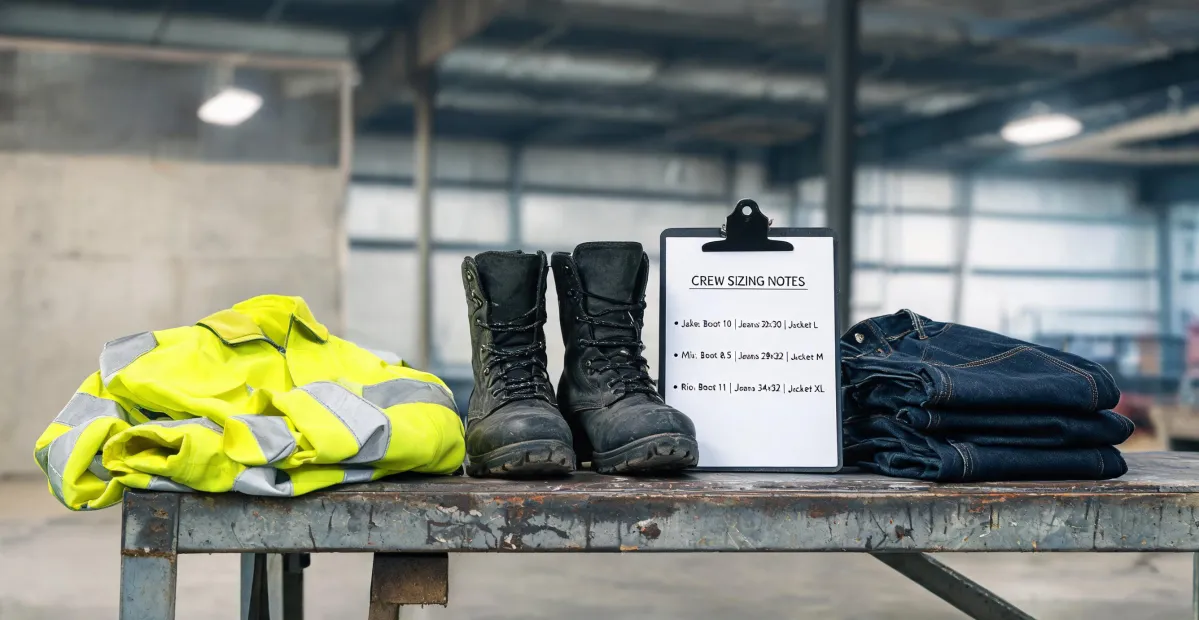
What I mean is: the difference between "Ariat FR cargo pants" and "Ariat FR cargo pants, size 38×32, Tan," can add or save a full day of shipping. You need exact model numbers, sizes, quantities, and any required certifications (like NFPA 70E for FR clothing).
Here's the trap: many people assume they know what 'standard' is for their crew. But 'standard' varies—some need flame-resistant shirts with hi-vis striping, some need plain. Some boots are steel-toe, some composite. One wrong spec and the entire order ships back.
Why does this matter? Because a single mis-specified item can delay your entire shipment. Vendor sends you size 40 instead of 38, and you're stuck reordering and waiting.
Action item: Open a spreadsheet. List every item, size, quantity, color, and special requirement. Double-check against your crew's actual needs. Yes, it takes 20 minutes. Compared to a week of back-and-forth, that's nothing.
Step 2: Build a Timeline Backwards – From Required Delivery to Order Placement
Most people look at a delivery window and think, "7 days, no problem." They don't account for processing time, potential stockouts, ground shipping delays (especially for boots and FR gear, which often ship separately).
I've learned to reverse-engineer it. If you need gear by Friday, ask yourself: can the supplier process the order in one day? Is standard ground shipping 2-5 days? Are the items in stock? If any answer is 'maybe' or 'no,' you're already at risk.
Sample timeline for a rush order (assuming all items in stock):
- Order placed Monday 10 AM
- Processing by Tuesday noon
- Ground shipping 2-3 days (arrives Thursday or Friday)
- Buffer: none (ugh)
Notice the buffer is zero. That's a problem. If any delay happens, you miss the deadline. The fix: pay for expedited shipping or source from a closer warehouse. Many safety gear suppliers offer split shipments—rush what you need, let the rest follow normal.
Here's a counterintuitive tip: sometimes ordering the day before an announced price increase (ugh) is actually cheaper than paying rush fees later. (Note to self: check pricing cycles more often.)
Step 3: Ask for Rush Options – But Compare Before You Click
This is where the decision hesitation kicks in. You have a quote for standard delivery at $2,500. Rush delivery is quoted at $3,800—an extra $1,300 for shipping alone. Is it worth it?
Here's a rule of thumb: calculate the cost of not having the gear. If a missed deadline means a $10,000 penalty or a lost client, then $1,300 is cheap. But if you're just saving a week of comfort, maybe not.
What to ask your supplier:
- "Is expedited shipping available for all items in this order?"
- "Can you split-ship the most urgent items via air and the rest via ground?"
- "Is there a discount for partial rush (e.g., only FR clothing shipped rush, boots ground)?"
I've saved clients $200-400 on rush orders just by asking for partial expediting. Vendors appreciate when you know what you need, instead of just saying 'rush everything.'
Real-world example (June 2024)
A client called at 3 PM needing 24 pairs of Ariat work boots, 12 FR hoodies, and 4 safety glasses for a site inspection the next morning. Normal turnaround: 5-7 days. We found a vendor with next-day air on the boots (paid $98 extra shipping) and standard ground for the rest (free shipping). The client's alternative was cancelling a $45,000 contract. (So glad we caught the stock status before ordering.)
Step 4: Ensure Your Backup Isn't Worse Than the Problem
Sometimes, despite best efforts, items are out of stock or delivery simply won't arrive in time. That's when you need a backup plan. But not all backups are equal.
Bad backup: Order from a random low-price vendor you've never used. Saved $80? Great. But if their sizes don't match spec, or their FR gear isn't certified, you're in a worse spot—and explain to OSHA why your crew wore non-rated clothing.
Good backup: Call a local safety supply retailer. Seriously. Many have walk-in stock of common sizes. Yes, you'll pay retail markup. Yes, it's annoying to drive across town. But having the gear > paying a premium in a genuine emergency.
I keep a list of three local suppliers that stock Ariat work boots and basic FR shirts for exactly this reason. (Mental note: update that list—one store closed last month.)
Bonus: What Most People Forget (And It Costs Them)
Specs change during rush. You ordered 12 FR cargo pants. Team member needs a different size. In a rush order, changing anything mid-process usually triggers a 1-2 day delay. Solution: order one extra of each common size (e.g., 34, 36, 38) and plan to return the extras later. Returning is cheaper than a reorder.
Shipping to a job site vs. office. If the job address is residential or a construction site, some carriers won't deliver there (or charge extra). Check before ordering.
Beware the 'availability guarantee' trap. Some vendors say "in stock" but actually drop-ship from multiple warehouses. Your order arrives in 4 separate boxes over 5 days. Ask: "Is everything in one warehouse?"
Final Thought: The Small Order Is Not the Enemy
When I started in this field, I'd cringe at $300 orders for one pair of boots and a FR shirt. But today, many of my $30,000 clients started with exactly those kinds of small, urgent orders. The vendors who treated those small orders with urgency are the ones I still recommend.
Small doesn't mean unimportant—it means potential. And in an emergency, every order deserves professional handling.
So glad you read this. Now go check those specs one more time.