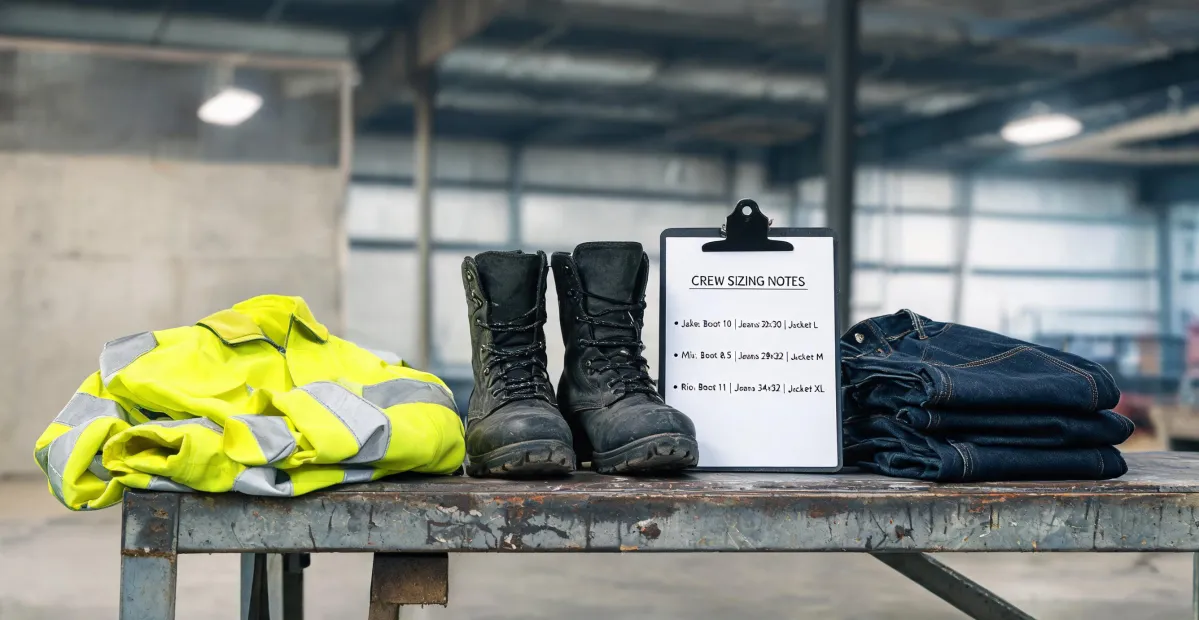
Let me start with something I've learned the hard way: there's no such thing as a "best" pair of Ariat work boots or a "perfect" FR shirt for every job. It depends entirely on who's wearing them and what they're doing. I manage safety equipment purchasing for a mid-sized manufacturing company—about 150 employees across two facilities. Over the past five years, I've placed hundreds of orders for boots, FR clothing, hard hats, safety glasses, and more. So when people ask me, "Which Ariat 6 inch work boot should I get?" or "Are FR Ariat shirts worth it?", my answer is always the same: it depends.
Here's how I break it down.
Three Types of Workers, Three Different Needs
The biggest mistake I see in buying decisions is treating every employee the same. A welder on the floor has totally different requirements than a site supervisor who spends half the day in meetings. And both of them have different needs than an electrician who's crawling around in tight spaces. So let's split this into three common scenarios.
Scenario A: The Hands-On Tradesperson (Fabrication, Maintenance, Welding)
These are the folks who wear their boots into the ground. They're on concrete for 10+ hours a day, dealing with sparks, oil, and the occasional dropped part. For them, durability and safety are the main priorities. I've settled on the Ariat 6 inch work boots with a Vibram outsole and steel toe. Why? Two reasons:
- Oil and slip resistance – The sole pattern actually works on greasy shop floors. I've seen too many slips from people wearing regular boots.
- Heel support – Standing on hard surfaces all day wears out the cushioning faster. The 6-inch height offers more ankle stability without being too stiff.
For FR clothing, these guys need FR Ariat shirts that are lightweight but durable. I've learned that heavier fabrics (like 7 oz or 8 oz cotton) trap heat and sweat, leading to complaints. A 5.5 oz FR shirt is usually the sweet spot. It's lighter, dries faster, and still meets NFPA 70E standards.
To be fair, I used to buy the cheapest FR shirt I could find. That cost us more in the long run—they'd rip after a few washes, and I'd have to reorder for the same people every six months. After 18 months of that, I switched to higher-quality FR shirts like Ariat's, and the failure rate dropped by about 40%.
Scenario B: The Supervisor or Mixed-Duty Worker (Office & Floor)
This is the person who's in and out of the shop. They need boots that are comfortable for walking but also safe for quick walk-throughs. For them, I recommend Ariat 6 inch work boots with a composite toe instead of steel. It's lighter and won't set off metal detectors. The trade-off: composite toes are slightly less protective against extreme impact, but for warehouse or light assembly use, it's fine.
For FR shirts, these workers usually don't need heavy-duty flame resistance because they're rarely in direct contact with arc flash or open flames. A lighter FR shirt, like Ariat's 4.5 oz line, works well. They're breathable enough for the office and certified for occasional exposure. Just make sure the shirt has a loose enough fit—snug-fitting FR clothing can be a hazard if it ignites.
I'll admit, I was skeptical about composite toes at first. Everything I'd read said steel toes are always better. But after ordering 60 pairs of composite-toe boots for our supervisors in 2024, the feedback was overwhelmingly positive—fewer complaints about cold feet in winter and less fatigue on long days.
Scenario C: The Electrician or High-Risk Worker (Arc Flash, NFPA 70E)
This is the most specific group. They need FR shirts with an arc rating (ATPV) of at least 8 cal/cm² for daily use, and higher for specific tasks. I always check the label before ordering. A lot of generic FR shirts claim to meet NFPA 70E but don't have clear arc ratings. For our electricians, I've standardized on Ariat FR shirts with an ATPV of 10-12 cal/cm². It's overkill for most tasks, but it covers the worst-case scenario without being too bulky.
For boots, they need non-conductive materials. I avoid steel toes here—an electrician stepping on a live wire with steel toes can create a ground fault. Composite toes are the way to go. The Ariat 6 inch work boots with a composite toe and electrical hazard (EH) rating are my go-to. They meet ASTM F2413-11 standards for electric hazard protection.
Here's a real example: in 2023, I ordered 20 pairs of steel-toe boots for our electricians because they were $35 cheaper per pair. Within three months, two guys had near-miss incidents when their boots sparked near live equipment. No injuries, but it scared them enough to demand proper EH boots. I replaced all of them—$2,100 down the drain. Now I don't cut corners on EH-rated boots.
How to Figure Out Which Scenario Applies to You
Not sure which group your team falls into? Here's a quick decision tree:
- If your workers are on their feet 90% of the day, in direct contact with grease, oil, or sparks → Go with steel-toe Ariat 6 inch work boots with a Vibram sole. Get the 5.5 oz FR shirt for daily wear.
- If they split time between the shop and office, or if they work in a warehouse → Composite-toe boots (lighter, less shock hazard). Get the 4.5 oz FR shirt for comfort.
- If they're electricians or working near arc flash hazards → Composite-toe EH-rated boots. Get the 10-12 cal/cm² FR shirt. Don't compromise on arc ratings.
And here's the part a lot of people miss: you also have to factor in your budget. We spend roughly $50,000 a year on safety boots and FR clothing. That's a lot. But I've found that spending a little more upfront on Ariat boots ($140-$170 per pair) saves us about $30 per pair per year in replacement costs compared to the $90 boots I used to buy. Same story with FR shirts—the $45 Ariat shirt lasts 18-24 months with proper washing, while the $25 generic shirt often falls apart in 12 months.
So when someone asks me, "Should I buy the cheapest pair of Ariat work boots or FR shirts?" my honest answer is no. Calculate the total cost of ownership—how long will they last, and how much downtime will you have replacing them? That $50 savings on boots could cost you $150 in lost productivity when someone has to go home early because their boots hurt.
In my experience, the right kit isn't about the brand name; it's about matching the gear to the work. Ariat makes solid boots and FR clothing, but they're not the right choice for every worker. The key is to understand who's wearing them and what they're doing. Once you have that clear, the choice gets a lot easier.
I've been doing this for 5 years now, and I still get surprised. The conventional wisdom says "always buy the best quality you can afford." In practice, I've found that sometimes the mid-range option delivers better ROI for certain roles. The real trick is knowing which role is which.
Hopefully that helps clarify things. If you're still unsure, feel free to get in touch—I'm always happy to share what's worked (and what hasn't) in my own purchasing experience.